“Fake news” – that’s how many people have learned about information challenges. However, this term does not appropriately reflect the problem that we encounter with false or misleading information. There is, in reality, no such thing such as “fake” news and “true” news. This binary way of thinking reduces the issue to a simple back/white or yes/no situation. Instead, we should think of a news and information as being defined by different spectrums of accuracy, bias, intent, … and also source, audience, and strategy.
In this post, I define some prominent types of undesirable information – propaganda, misinformation, and disinformation – and provide further readings on the subject.
Propaganda
Misinformation
📘 See A Dictionary of Media and Communication (3 ed.) by Daniel Chandler and Rod Munday for simple definitions.
Disinformation
Disinformation is the dissemination of information that is deliberately false or misleading, with the intention to deceive or hurt its target audience. The term originated from Russian dezinformatsia and is derived from French dés-information. Because it is very difficult to determine intentions objectively, scholars have increasingly preferred using the term ‘misinformation’, which is neutral about intentions. ‘Disinformation’ has been increasingly seen as a politicised concept.
📔 See the Final Report of the EU’s High-Level Expert Group on Fake News and Online Disinformation for an overview of challenges and solutions from a European policy perspective.
📙 See this Disinformation Annotated Bibliography by Gabrielle Lim for an overview of recent literature.
Conclusion
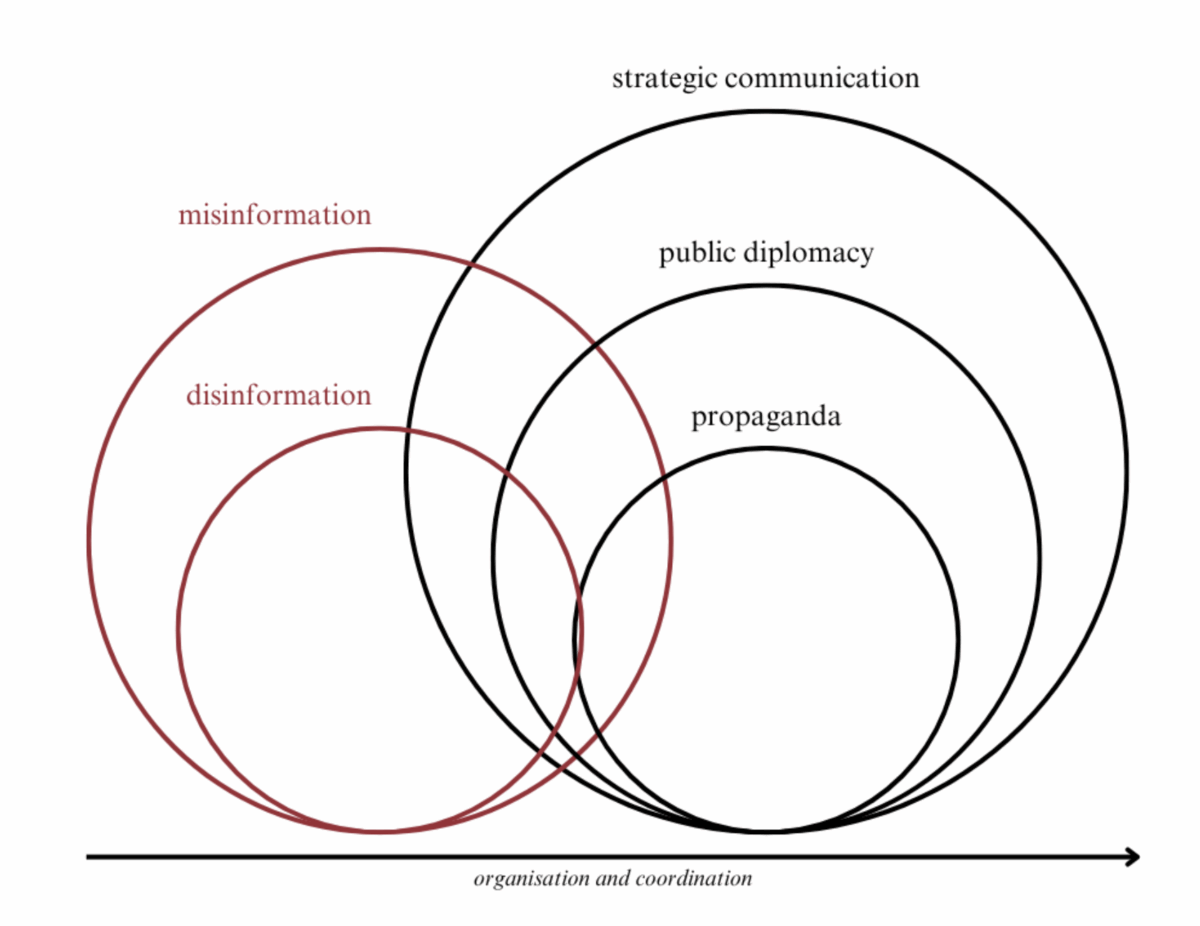
The defining lines between propaganda, misinformation, and disinformation are thin. We can think of these concepts as being subsets of communications and strategic communications (see Figure below). In practice, they can take place at various levels, local or international, and between all kinds of actors, private or public, individuals or groups.
These phenomena have gained a lot of attention in the media and policy circles, not without challenges for their study. A growing scholarship has been critical of misinformation studies, pointing methodological and conceptual shortcomings, as well as politicisation.
Working towards a more optimised information system is essential for progress, peace, and justice. Therefore, understanding the key framings of information challenges is a crucial step in the right direction.
Written by Sophie L. Vériter
Learn more
In my latest book chapter, I explain the difference between key concepts related to misinformation and disinformation, and provide a rich overview of the state of research in this field, joining insights from International Relations, Diplomatic Studies, Communications Studies, Computer Science, and Psychology.
Vériter, S.L. (2025). “Undesirable Information Online: Unpacking the Complexity of Propaganda, Misinformation, and Disinformation” In G. Christou, W. Vosse, J. Burton, and J.A. Koops (eds.) The Palgrave Handbook on Cyber Diplomacy, Palgrave Macmillan. https://link.springer.com/book/9783031933844