As part of my ongoing exploration of how technology is reshaping governance and society, I had the immense privilege of speaking with Eric Tak, Head of the European Central Bank’s Product Proposition Division of the Digital Euro Directorate. His team defines the digital euro’s product offerings for consumers, merchants, and intermediaries, focusing on key use cases such as person-to-person payments, e-Commerce, and transactions in physical shops. Beyond functionality, they also work on digital financial inclusion and the project’s environmental footprint.
Before joining the ECB, Eric built an impressive career at (among others) ING, where he served as Global Head of Retail Payments, shaping the bank’s global strategy and contributing to major European initiatives like iDEAL and EPI. In this interview, Eric shares his insights into the opportunities and challenges of developing a “digital euro” — a digital form of cash — and what it could mean for the future of Europe.

Eric Tak is Head of the ECB’s Product Proposition Division for the Digital Euro, leading the design of its use cases for consumers, merchants, and intermediaries. His work also addresses financial inclusion, compensation models, holding limits, and environmental impact, coordinating closely with stakeholders to shape distribution model. Before joining the ECB in 2024, Eric was Global Head of Retail Payments at ING, where he directed the bank’s global payment strategy and helped design major payment schemes like iDEAL and EPI.
What led you to work on the digital euro project?
I’ve been interested in sovereignty and strategic autonomy for a while. Having worked in payments since the early 90s, I realised how dependent we were on US-based companies such as Visa and Mastercard. When the EU and the US imposed sanctions on Myanmar, in response to human rights violations, we were not able to effectively control those sanctions after the US themselves lifted their sanctions, which means that the Visa and MasterCard payments were working perfectly between the EU and Myanmar.
This also happened the other way around, when the US decided to ban all MasterCard and Visa payments in Russia after their invasion of Ukraine. But, hypothetically, what if we as Europeans did not want that? We wouldn’t have had a choice. Similarly, the US decided MasterCard and Visa could no longer be used to fund Wikileaks. Regardless of whether you think these are Robin Hoods and liberators, or a national security threat, or a bit of both, I think in Europe we want to decide for ourselves whether or not we think it’s something that we should block or not.
Currently, while are fully independent in our political decisions, our hands are somewhat tied when it concerns payments. How you can pay, around the world, is in majority decided by the US government. From all these types of incidents and knowing that we pay a lot of money to MasterCard and Visa in Europe, an amount understood to be in excess of EUR 13.5 billion per year, it makes you realise that we are actually renting a core infrastructure.
We should have a fallback in case something happens. Of course, for a very long time we thought the US will always be our ally, and that got us into hot water on a lot of strategic topics. And you might argue, is this the most important one? Well, if payments don’t work, the economy comes to a standstill.
This made me want to do more to make Europe more sovereign and independent in its financial system. This is one of the topics where I can contribute, so I’ve been working for a long time on building European sovereignty, from a private sector perspective.
🏢
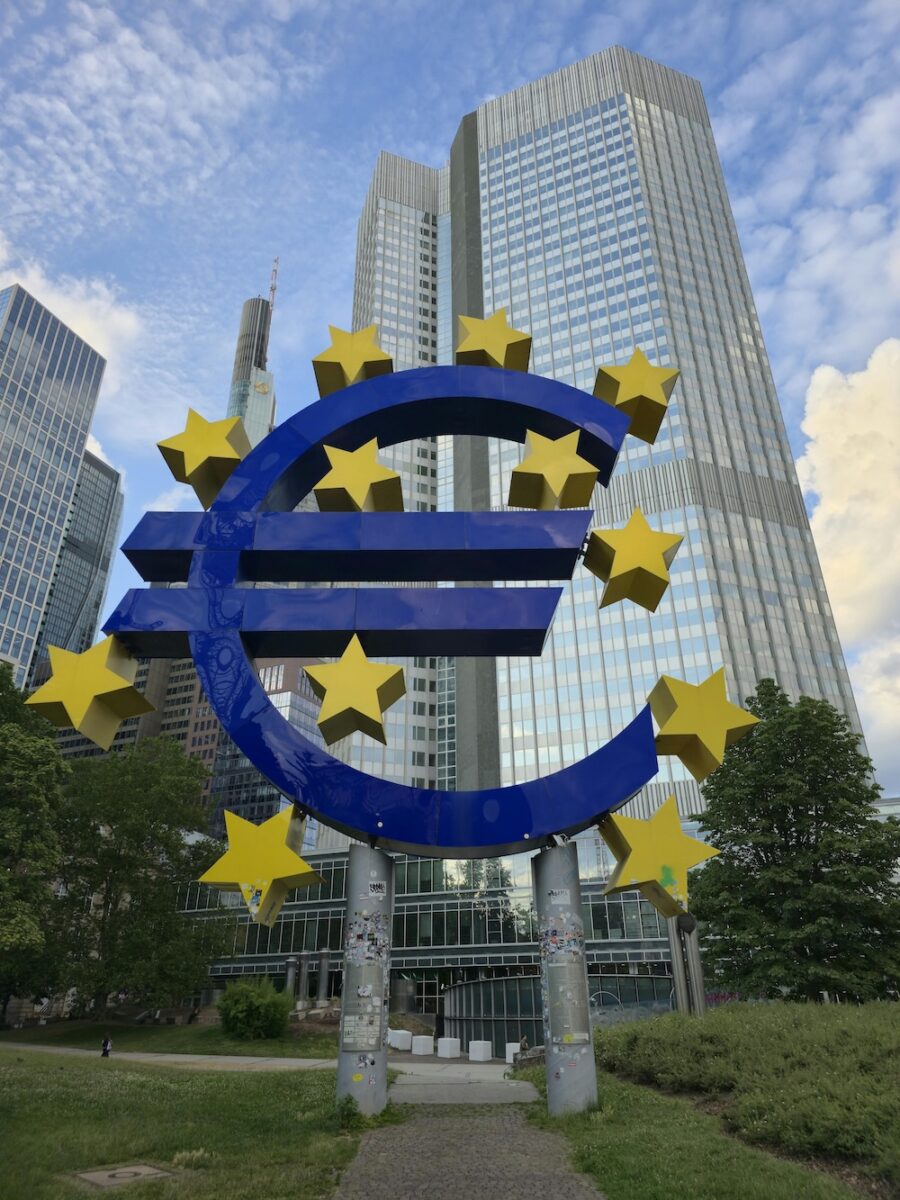
The European Central Bank (ECB) is the central bank for the 20 EU countries that use the Euro. Its main role is to maintain price stability by keeping inflation at 2% over the medium term. To achieve this, the ECB controls key interest rates and manages the money supply through monetary policies (e.g. buying/selling bonds). The ECB also has the exclusive right to authorise the issuance of Euro banknotes, manages foreign currency reserves, and promotes the smooth operation of payment systems across the euro area.
How can we contribute to European financial sovereignty?
The last initiative I worked on for the Netherlands is something called the European Payments Initiative, which has a product called Wero, which is now being rolled out in France, Germany, Belgium, and The Netherlands next year. It replaces payment apps like Payconiq in Belgium, to have something European as an alternative, which I think is a good idea for the private sector to do.
Initially I was not sure if European sovereignty would require, let’s say, state intervention or EU intervention. But increasingly I saw that private sector solutions could never cover everything, for a number of reasons.
💶
Central bank money, also known as public money, is created by the ECB in Europe and includes the cash we use daily. In contrast, private money is created by commercial banks when they issue loans, covering most digital transactions made with cards or online services. Currently, the public can only access central bank money in physical form (cash), but a digital euro would make it available also digitally. This shift would enhance payment efficiency, privacy and security while keeping money under public oversight.
So, why developing a digital euro?
Cash is the only form of public money that’s around. In comparison, private money exists in many different digital formats. There’s currently no digital form of public money. Of course, not many people in society realise that there’s a difference between central bank money and commercial bank money. But there is, and that has a lot of advantages. For the central banks and the economy, it’s a monetary anchor: you always know that the euro is worth a euro. But cash also has a number of other features we want to maintain, for example privacy, accessibility, and resilience to attacks on infrastructure.
The usage of cash has gone down quite dramatically, accelerated by COVID. It’s understandable, because in order to pay with cash, you first have to go to an ATM, which is extra activity, and you can’t use it online. Also, currently, I can only give you cash if you’re in front of me. There have been very attractive and convenient new digital ways of paying each other, which have become successful, but they don’t have some of the advantages of cash, at risk of disappearing.
What are the key advantages of a digital euro?
In summary, the digital euro has four key advantages for European consumers and society at large:
- Privacy: the digital euro would mirror the privacy of cash to the extent possible, but in a digital environment, protecting sensitive transaction data (for example, spending related to health, religion, political beliefs, or personal gifts) from being misused.
- Resilience: cash usage is rapidly declining, reducing society’s ability to cope with system outages or disruptions where cash was traditionally the fall-back in case of a problem with payment by cards. The digital euro would act as a backup payment method in case of technical failures, cyberattacks, or broader crises, ensuring transactions can continue even during emergencies.
- Inclusion: many modern digital payment systems exclude unbanked, semi-illiterate, elderly, or visually impaired individuals who lack access to modern smartphones or apps. The digital euro would ensure universal access, including options for physical cards and simple onboarding methods such as cash top-ups at bank branches or post offices.
- European governance and interoperability: today’s fragmented payment landscape — with over 130 payment methods across Europe — limits smooth transactions across borders. The digital euro would create a European, public alternative (governed by the ECB) accepted for peer-to-peer, online, and in-store payments throughout the eurozone.
Together, these features position the digital euro as a public good designed to enhance trust, stability, and accessibility in Europe’s evolving digital economy.
🔢
Tokenisation replaces sensitive data (like a payment card number) with a unique, non-sensitive token that holds no value if intercepted. The actual data is securely stored elsewhere, which ensures privacy and protection against fraud. For example, when you add your card to Apple Pay, the real card number is never stored or shared. Instead, a Device Account Number (DAN) is generated and kept safely in your device. This token is used for every transaction, safeguarding the actual payment details.
What is often misunderstood about the digital euro?
It’s much simpler to think that there’s just one factor driving everything, but reality is far more complex. There’s a great book, Future Babble, that I always recommend. It looks at the predictions of so-called gurus, people writing books on oil prices, interest rates, or other big trends, and studies how accurate they were. Unsurprisingly, the accuracy is quite low. For example, in the 1990s, everyone was convinced Japan would keep rising forever, but that moment turned out to be its peak. At the same time, hardly anyone mentioned China, or if they did, they predicted it would never amount to much. The author describes two types of predictors: “hedgehogs,” who say one factor explains everything (and who sell more books but are usually wrong), and “foxes,” who recognise complexity, include multiple variables, and end up being more accurate, even if less popular.
This is a flaw in human storytelling: we want things to be simple. But when it comes to the digital euro, as with many other things, the reality is complex. I see the digital euro as a necessary complement to whatever the private sector does, even if the explanation isn’t that simple.
What are your core priorities in developing the digital euro?
The private sector will never be able to cover everything we need. The digital euro, because it’s going to have legal tender status, will also have mandatory acceptance. This means all merchants, online and in physical stores, will have to accept the Digital euro, just like they accept cash today. This ensures full acceptance. That’s not the case everywhere now. For instance, in the Netherlands, there are trendy coffee shops where you can only pay digitally. But even that is changing, as new Dutch legislation is expected to come in, legislation that will eventually be superseded by European law, that obliges merchants to accept cash as a form of payment.
The idea is that, with mandatory acceptance and distribution by banks, the Digital euro will always be available. Consumers won’t be forced to adopt the digital euro, but the option will be there, providing a reliable backup that works everywhere. Of course, this all depends on the digital euro regulation currently being discussed in Brussels. They’re the legislators, we only execute. We have our opinions, of course, but ultimately, it’s the regulation that will give the digital euro its legal tender status and enforce mandatory distribution and acceptance.
📕 Finance Technology Glossary
- FinTech (Financial Technology): Technology-driven innovations that aim to improve and automate the delivery and use of financial services, making them faster, more accessible, and often more user-friendly.
- DeFi (Decentralised Finance): Financial services built on blockchain networks that operate without traditional intermediaries like banks, allowing peer-to-peer lending, trading, and more.
- ECB (European Central Bank): The central bank for the Eurozone, responsible for monetary policy, issuing the Euro, and overseeing financial stability across EU member states using the Euro.
- CBDC (Central Bank Digital Currency): A digital form of a country’s official currency, issued and regulated by its central bank, intended to complement physical cash (e.g. digital euro).
- Stablecoin: A cryptocurrency pegged to a stable asset like fiat currency (e.g. the US Dollar) to reduce price volatility, often used in payments and trading.
- eMT (Electronic Money Token): A privately issued digital token representing electronic money, regulated under the EU’s e-money framework, distinct from a CBDC; unlike many stablecoins, eMTs must comply with strict regulatory standards ensuring consumer protection and redemption rights (e.g. to ensure that customers can redeem their tokens at any time).
What sets Europe’s vision apart from the US or China?
The situation in Europe is quite unique. We’re the only example of a currency zone that spans multiple countries, whereas payment solutions have traditionally been built at the national level. This creates a level of fragmentation specific to Europe. In the US, you have domestic systems like MasterCard and Visa that operate nationwide and worldwide. In China, there’s UnionPay, which has become less relevant with the rise of Alipay and WeChat Pay, but it still exists as a national solution. Europe, by contrast, doesn’t have a single solution that covers the entire region and when something comes close to that, it’s non-European.
In the US, there was some interest in Central Bank Digital Currencies (CBDCs) under the previous administration, but the current one has taken the opposite approach, favouring private-sector stablecoins instead. China’s position is different again, as they are currently experimenting with their eYuan. When transactions are documented, it becomes much harder to cheat on your taxes, and that’s often a bigger driver for governments than any desire to spy on their citizens or limit and control their spending, as some conspiracy theories claim.
Of course, some of the concerns come from the fact that once you have the data, you could use it, or a future government might. That’s where some of the worries start. Therefore, the digital euro is designed to capture as little data as possible and ensure that the ECB cannot see any transaction data of citizens.
In countries like India or Brazil, for example, you see alternative models with systems like UPI and PIX. These are government-mandated schemes but run on private-sector rails, using the existing account-to-account infrastructure. Banks are required to distribute it for free, which has led to a sharp decline in the market share of MasterCard and Visa. The downside is that banks aren’t happy, since they can’t charge for it. And importantly, it’s still commercial bank money, not central bank money. So, while it meets some of the criteria we want to achieve, it doesn’t fully align with the principle that central bank money should always be available.
From the ECB’s perspective, we don’t comment on what other countries do. But we do think our position is unique. Also because of the digital euros’ privacy-by-design, which makes direct comparisons to other initiatives difficult.
How is the ECB preparing EU citizens for the digital euro?
We will step up communication once the regulation has been adopted (it’s expected for 2026), because until then, it’s not certain that it will happen. And we also know that payments is a low-interest topic for most people, except for a few nerds like me. So, we don’t want to start too early. If you say, “there will be something in two years’ time,” most people will think, “whatever.” At the same time, we do publish information on social media and our own site, but that’s more factual. In the background, we’re working on how to position this and how to explain it. Maybe the name: “digital euro” is not as clear as something like “digital cash.”, especially as most citizens see their (commercial bank) euros as already being digital.
What’s certain is that we’ll need to do a lot of explaining. But it doesn’t all have to come from us. We can also work with retailers, who can inform their customers, and with banks, who can explain it directly to their clients. And while the overall storyline is universal across Europe, the emphasis may differ by country. For instance, peer-to-peer payments to people in your address book could be a great feature in some countries that do not have such a solution. In Spain, for instance, this won’t matter that much since many people already use the local solution Bizum. But in Austria, where there’s nothing like that yet, it could be very relevant.
What are some common myths about the digital euro?
There are some extreme conspiracy theories floating around on the Internet that basically claim that digital identity wallets and CDBCs are an Orwellian way of enabling the mass surveillance of people. That is one of the reasons why the European Commission has introduced very strict privacy requirements for the digital euro. For instance, we use something called pseudonymisation. This means that we only see reference numbers, and we don’t know who is behind them. Only the bank that provides you with the digital euro knows that it’s Sophie, for example. For us at the ECB, it’s just a number. We don’t know anything else, not even transactions.
And even if, in theory, a government wanted to force a bank to share all your payment data, that data doesn’t actually reveal that much. Payment card data today contains the exact time of the transaction, a geolocation, and a merchant category code (MCC) like “hospitality.” But it never includes the line items of what you actually bought. So if you shop at Albert Heijn and spend €23, the system doesn’t show whether you bought locally grown vegetables, a crate of beer, or avocados imported from far away.
This is why some of the stories, about the EU imposing CO₂ budgets or governments blocking people from buying meat or airline tickets, don’t hold up. In fact, to the extent that tracking would possible, it is already possible today with bank cards. Nothing new would be introduced with the digital euro.
At the ECB, we explain carefully how privacy will be protected. There will even be an offline version of the digital euro, which offers cash-like privacy: no-one except the consumer knows where it goes or where it comes from, and transactions are not even registered. Of course, if you distrust the ECB, then whatever we say may not convince you… but the safeguards are there.
The digital euro will neither be mandated to use for any EU citizen, nor will it have “programmability” (the ability to embed conditions into payments, for example, rules about when, where, or how funds can be used) — contrary to what some people have been suggesting. For the digital euro, it’s always going to be just an option.

Which innovations might the digital euro introduce?
What could happen is conditional payments: that you buy something online but the payment is only released to the seller if you have received your goods. We will build the basic payments functionalities and then work with the private sector who can build innovative solutions on top of that.
How do you make sure programmability safeguards hold?
We have a rulebook development group where we sit with the private sector (merchants, consumers, banks, acquirers and others) so they can see the designs, and our design doesn’t contain programmability (rules that would limit the private use of the digital euro). Even though some people might say, “Why not put the code in there so you can activate it if opinions change later?”… we won’t do that. Building a backdoor would create distrust. And history shows us that even in countries we thought were stable, regime changes can happen quickly. We don’t want to build a future risk of abuse.
So, unlike stablecoins or e-money tokens (EMTs), which allow much more programmability, we deliberately stay away from that with the digital euro. We are unlikely to build the most innovative payment solution. Private sector companies are more likely to do that. Consumers don’t expect something primarily “flashy” or “cool” from us either. What they expect is something solid, reliable, convenient, and safe — that’s our main focus. We’re not aiming for a large market share either. We mainly want broad adoption so that the digital euro is there for everyone if ever needed, and to absorb possible further reduction in the usage of cash. Yet we will ensure physical cash also remains available las along as there is a demand for that.
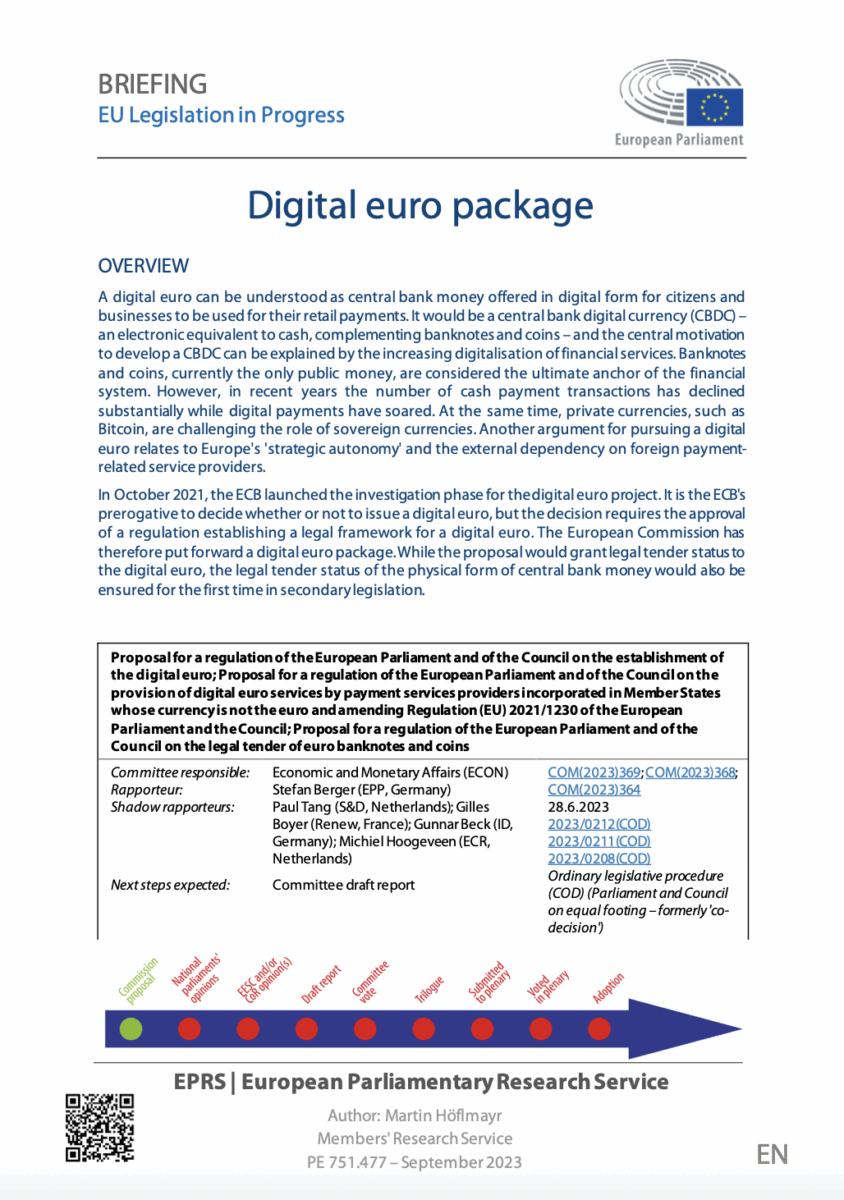
The Legislative Process of the Digital Euro
The digital euro package, proposed in June 2023, establishes a framework for a retail CBDC to complement cash, ensure access to public money, and strengthen Europe’s monetary sovereignty. It includes regulations on the digital euro’s establishment, the legal tender of cash, and rules for payment providers in non-euro states.
How do you see the European start-up ecosystem working with the digital euro?
We see coexistence. Card rails, account-to-account, crypto, stablecoins,… they can all exist in parallel. End-users will choose what works for them. But the digital euro will also act as an innovation platform. We provide the basic payment layer, and private sector actors can build value-added services on top. For example, conditional payments could be monetised, like paying 50 cents extra for an insurance that your money is only released when goods arrive.
We’re working with two groups — “pioneers” and “visionaries” — on use cases. Almost 70 parties have joined workshops to develop ideas. A report with these examples will be published soon, likely in September/October. The advantage is that any service built on top of the digital euro benefits from pan-European mandatory acceptance. Normally, launching a new payment method requires convincing every merchant to upgrade hardware. But with the digital euro, reach is guaranteed.
What about stablecoins and EMTs?
From the ECB perspective, stablecoins pose risks to monetary policy, especially since about 98% of them are USD-based. If they scale massively, they could undermine the Euro’s relevance. In payments, we currently see three main use cases for stablecoins:
- Inflation hedge in unstable economies (e.g. in Turkey or Argentina).
- International payments are faster and cheaper, though on/off-ramp costs reduce the benefits.
- Remittances and unbanked populations, especially in regions with weak financial infrastructure.
In Europe, where payments are already cheap and instant, stablecoins bring less value. But globally, especially where incumbent governments leave gaps (like in the US), they may thrive. Also, other use cases may emerge over time. It would be healthy to see Euro-denominated stablecoins, and there are rumours European banks will launch some soon. But given Europe’s efficient payment systems, usage here will likely remain limited for consumers, most likely.
Conclusion
The digital euro won’t make headlines for being flashy, and that’s precisely the point. It is being built as a quiet backbone rather than the next payments craze. What stood out in my conversation with Eric Tak is how much of this project is about trust: trust that your money remains yours, trust that privacy isn’t sacrificed, and trust that payments keep working no matter what. Unlike private wallets or stablecoins, the digital euro is not there to compete for market share; it is intended to guarantee a safe public option that belongs to everyone. I like to think of it as Europe laying down its own bedrock, so that innovation and creativity can play freely on top. In a world of fragmentation and rapid change, the digital euro is Europe’s reminder that simplicity can itself be a radical act.
About Eric Tak
Eric Tak has headed the ECB’s Product Proposition Division of the Directorate Digital Euro since June 2024. The Division defines the product offerings for consumers, merchants and intermediaries, focusing on key digital euro use cases such as Person-to-Person (P2P) transactions, eCommerce, and Point-of-Sale (POS) payments. It also manages project activities related to digital financial inclusion, the digital euro compensation model, the setting of holding limits and considerations around the environmental footprint. Eric is responsible for managing the design and refinement of the digital euro product proposition, including the distribution model via payment service providers, liaising closely with internal and external stakeholders.
Before joining the ECB, Eric had dedicated much of his career to ING, where he worked as Global Head of Retail Payments until October 2023. In this role, he was responsible for defining and executing the group’s global payment strategy and roadmap, as well as overseeing the implementation of its payment programmes across all retail segments and countries. Additionally, he was a member of the board of the European Payments Council and was involved in the design, set-up and operation of different payment schemes, including iDEAL and EPI. Eric holds a master’s degree in business economics from Vrije Universiteit Amsterdam.

Hi! I’m Sophie
I am a social scientist and explorer. In my work, I analyse the intersection of politics, technology, and democracy. Nothing makes me happier than learning and discovering the wonders of the world. I consider myself an enthusiastic feminist and self-care advocate.