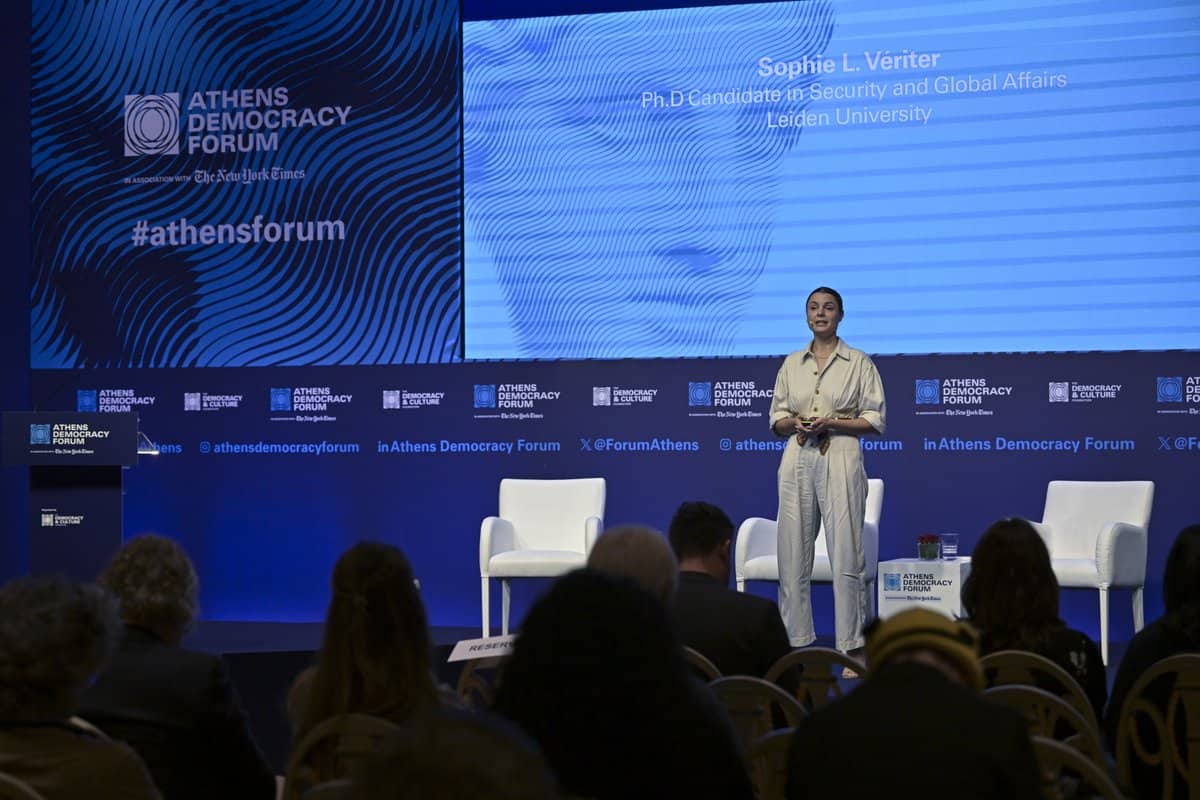
Last month I was invited to speak at a consultation on the New Democratic Pact for Europe, convened by the Council of European Municipalities and Regions (CEMR) and the Council of Europe’s Congress of Local and Regional Authorities. We discussed the role of local governments in safeguarding democracy in the face of misinformation and eroding public trust. Following my intervention, I was asked how we could separate truth from fiction and emotions, to return to fact-based public discussions. This question, however loaded and complex, echoes a longing for anchoring public debate in a shared understanding of reality. It asks if and how we can connect in politics. This inquiry has stayed with me ever since, and is the subject of this essay.
As a social scientist, I’ve been formatted to pursue objective “truth” in my work; to identify facts on which we can collectively agree and verify as accurate. For that, we scholars use scientific methods, logic, and controlled environments that extract very specific answers to very specific questions. We pride ourselves in the publication of those findings which we, then, declare facts. Yet, when we turn to politics, the pursuit of truth becomes far more complex. States, institutions, and societies do not operate under the same constraints as science; they interpret and contest truth through the prisms of identity and power. What counts as “true” is shaped by perceptions of authority, as well as narratives that integrate information into what is socially accepted — and that varies widely across the world. Regardless of the evidence, these socially constructed notions of “truth” deeply influence global affairs. This dilemma raises two questions: Can truth itself ever be neutral? And should truth be separated from fiction and emotion?
"Truth" in World Politics
In the field of International Relations (IR), the concept of truth occupies a central position. Far from being a merely philosophical concern, the meaning of “truth” cuts across questions of legitimacy, power, and epistemology (how is knowledge acquired?). IR has long taken for granted the positivist assumption that “truth” corresponds to reality and can be objectively discovered through empirical inquiry. However, this view obscures how “truth” is historically and politically situated, like a snapshot corresponding to a given socio-political context. In 17th-century Europe, you could get executed for suggesting that the Earth revolved around the Sun, since it wasn’t in line with the then-accepted “truth” that Earth was at the centre of the universe. More recently, research on the 2003 US war in Iraq revealed how notions of “truth” related to the global “war on terror” were fabricated to serve political and industrial agendas (see Speer, 2017 and Butt, 2019). Claims of accuracy have always been used as instruments of power, hence why “truth” must be understood as a dynamic concept, one that evolves within space and time.
Traditional IR scholarship, particularly realism, has been rooted in a model of anarchic “truth”. Realist theory presupposes a world revolving around self-interested and power-driven human nature. The acceptance of this view, now vastly criticised, was considered a prerequisite for sound policy and prudent diplomacy and still underpins much of modern politics, especially in the so-called Western world. However, in the late 20th century, constructivist scholars challenged this fixed notion of “truth”. Wendt, Kratochwil, and Onuf all argued that the international realm is constituted by evolving language and social norms, meaning that what counts as true emerges intersubjectively through human interactions — and increasingly also from technological interactions (see Floridi, 2014). In this view, truth is not “out there” waiting to be discovered but rather co-produced through communication, laws, and institutions. Hence, “truth” cannot be separated from the cultural and normative orders that sustain it. This epistemological shift replaced the search for objective certainty with the analysis of how actors construct shared understandings of reality, for example through novel branches of science that examine complex networks.
The latest research on world politics shows that “truth” is more often than not bound to a specific spatial and temporal context. Just as the nature of particles depends on how they are observed — as illustrated by Schrödinger’s cat experiment — “truth” in contemporary political debates depends on how it is extracted and interpreted. This is not to say that nothing can be established as fact: there are indeed commonly accepted facts, especially in natural sciences, such as the Earth orbiting the Sun or water boiling at 100°C. Yet, in politics, most observations are contested and tend to vary based on context. Critical IR theorists have exposed how this context-dependent nature can be weaponised, when information is controlled to sustain power. Adler and Drieschova (2021) conceptualised “truth-subversion practices” as deliberate efforts to undermine the epistemic foundations of the liberal international order through disinformation, double-speak, and contradiction. Therefore, in answering the first question of this essay, truth is rarely neutral, it is context-dependent. To get to a common ground of understanding around questions of politics, it is necessary to consider the biases, belief systems, knowledge traditions, and emotions that affect our individual experience and version of “truth”.

Affective Dimensions of Truth
Reflecting on the idea — now debunked — that truth can be fully separated from emotions, a doctoral student who was in the room shared: “I don’t think truth should be separated from emotions. Emotions are what make us remember certain things more than others, it helps us process information, it is how we understand facts”. This observation follows the notion that truth is shaped by its context: if truth is socially constructed, its ontology (its fundamental nature) is intrinsically connected to the social frames that underpin it. Stories have always shaped the way we think about the world, with vast consequences for human and technological development. To know more, or better, we should therefore evaluate more, not less, the nuances that surround the complex issues we constantly try to decrypt, like politics or economics and development. In other words, to reach a shared understanding in political debates, we need to acknowledge the different personal and cultural lenses through which people interpret reality — including and especially ourselves.
Hence, psychologists who specialise in countering misinformation have developed response frameworks that generally consist of five elements: (1) “pre-bunking” or decrypting information and how it can be manipulated, (2) analysing the scientific or social consensus, (3) validating other worldviews, (4) accepting that changing one’s mind is normal, and (5) showing interest and care. Having been in long conversations with many different people who believe in some conspiracy theories, I can personally attest to the efficacy of these techniques when used together. More often than not I have found that, with patience and empathy, it is possible to find a common ground from which we can have productive discussions, if we can discuss information in light of its cultural and emotional context. And, yes, that also involved recognising some of my own biases and putting them aside, however difficult and frustrating that feels, at first.
Technology for “Truth”
So how do we get better at doing all those things? The solution lies in better education policy and technology. First, to better decipher information and its manipulation, we need quality education easily accessible to a broad range of audiences and adapted to their needs. Education in the 21st century needs to be in line with our fast-changing, tech-driven world. It must integrate media and digital literacy in every single aspect of life and empower citizens through high-quality journalism as well as civic and financial education. With AI, the opportunities are endless when it comes to personalising education, but there’s also risks involved with concentrating power in the hands of a few companies that have a huge influence on modern-day “truth arbitrators” (such as OpenAI, xAI, Google, or Microsoft).
I’ve seen AI models such as Grok AI or ChatGPT being presented and used as tools to verify information and settle disagreements over the accuracy of information. Similarly, AI-enhanced deliberative democracy has been studied as a potential means to find common ground across collective preferences. It’s extremely important to know that AI models are, however, all biased in some way, and that there’s no such thing as “unbiased” or “conscious AI”. The notion of Artificial General Intelligence has also been highly contested in science. Computational linguists have demonstrated that large language models generate text by statistically mimicking language patterns rather than understanding meaning, making them inherently biased and potentially harmful if treated as intelligent or objective systems. Therefore, it’s crucial to take AI-generated “truth” with a grain of salt, and always analyse it critically (see my short guide on how to consume news critically). It’s also important to come up with more grass-root and decentralised solutions to balance out the huge influence of the few private actors currently leading the AI race, who have a clear interest in gaining more power and maintaining an information system that is skewed in their favour.
Second, we must strengthen our emotional awareness and resilience, our capacity to empathise for others and to understand the collective benefits of reducing inequalities, of caring for strangers, and of seeing their differences not as a threat but as an opportunity to learn — that requires tremendous intelligence. For that, I have found that what helps the most is… reading fiction. Granted, non-fiction books such as Rebel Ideas: The Power of Diverse Thinking (Syed) and Mindset: The Psychology of Success (Dweck) were foundational for my understanding of the value of disagreement and varied perspectives. However, it was by reading novels that I developed my capacity to see reality through someone else’s eyes, and understand the unique power of each perspective. From French classics like L’Étranger (Camus) and La Nausée(Sartre) to English literature such as 1984 (Orwell) and The Voyage Out (Woolf), fiction has helped me grasp the quality of the most peculiar minds. It empowered me to be more reflective, critical, and open-minded, to see the archetypes and story arcs that guide most of the things we do daily, to understand reality through different points of views. Fiction has the capacity to communicate ideas that science cannot. And last but not least, fiction allowed me to be creative and imaginative in ways that science and machines never could.
☕️
Are you enjoying this post?
If you’ve enjoyed reading my blog, learned something new, or found inspiration here, consider supporting me:
Conclusion
In The Origins of Totalitarianism, Hannah Arendt wrote: “The ideal subject of totalitarian rule is not the convinced Nazi or the convinced Communist, but people for whom the distinction between fact and fiction… true and false… no longer exist.” While I adore Arendt, and she’s right about many things, this essay has shown that fact and fiction are actually more closely related than what we may think, and it isn’t so bad. Building on International Relations theory, it showed that “truth” is a dynamic concept that is tied to a specific spatial and temporal context. It also showed that it isn’t always bad to recognise the dual nature of things, to see that “truth” can be seen in two different and completely valid ways at the same time. It made a case for better technology for “truth”, i.e. education adapted to modern-day needs and tools, and warned against the dangers of seeing AI models as objective arbitrators. Lastly, it explained how powerful fiction can be to help us understand the unimaginable, to imagine the impossible, and to anchor it within accepted frames.
In a world torn by polarisation, being able to build bridges between different worlds and belief systems will be a crucial skill, a probably a defining one for this century. Rather than seeking to separate facts from fiction and emotions, I argue that we should learn more about how interconnected they are, to help us find the common bases on which we can agree and connect.
Humans have always been confused (how could we not be, existing on a floating rock in space?). Truly, we’re just starting to grapple with the scope of that confusion, and with that realisation comes a mix of fear and excitement. Fear of repeating past mistakes and missing opportunities for progress, and excitement to fine-tune knowledge and policy in line with the latest advances in science and technology. We’re only starting to understand the complexity of the socio-political systems around us and how they shape our lives. To answer the longing for a public common ground that I referred to in this introduction, we must allow ourselves to step aside the rigid notions of what’s true, acceptable, or correct, and leave room for understanding and living through the world in ways that have never been done before. To reconnect and trust each other like never before, we must be honest and creative like never before.
Written by Sophie L. Vériter, Ph.D.

Hi! I’m Sophie
I am a social scientist and explorer. In my work, I analyse the intersection of politics, technology, and democracy. Nothing makes me happier than learning and discovering the wonders of the world. I consider myself an enthusiastic feminist and self-care advocate.