Five strong forces are reshaping the digital communications environment in 2026. First, AI-generated content has flooded every channel, with AI slop appearing everywhere. Second, this has led audiences to flee toward human imperfection. The creator economy is absorbing the authority that traditional media is losing. Third, search traffic is being swallowed by AI engines, cutting access to audiences and redefining how businesses and journalists reach out. Fourth, institutional trust is eroding under coordinated pressure and capture of media ecosystems. And, fifth, the platforms that once reliably carried messages to audiences are fragmenting into decentralised spaces.
Each trend is significant on its own. Together, they describe a communications environment that operates on fundamentally different assumptions than the one most strategies were built for in previous years. This post delves into each issue and provides tips to adapt to new communication trends.
The Rise (and Fall) of AI-Generated Influence
AI-generated influencers and bots have invaded social media. Virtual personalities like the monk Yang Mun have gained millions of followers on Instagram. Content creator Shalev Hani claims to be behind this AI-generated character, who shares wisdom on health and mindfulness from what appears to be a Buddhist temple. With Yang Mun, he says he gained over USD 300,000 in profit in 90 days. The appeal is clear: low costs, 24/7 availability, complete creative control. The problem is equally clear: enthusiasm for AI-generated creator content has plummeted from 60% in 2023 to just 26% in 2025, revealing growing skepticism and distrust towards synthetic content. There is a visible backlash against AI slop.
However, the AI content problem runs deeper than consumer taste. The Reuters Institute’s 2026 Journalism and Technology Trends report documents something structurally alarming: the proliferation of AI content farms designed to deceive. Automated fake news sites, synthetic news anchors presenting fabricated stories, and AI-generated videos deployed as political weapons during elections across the world are now integral parts of the information ecosystem. In the Dutch elections, a far-right leader opened his campaign with an AI-generated video depicting a dystopian future in the Netherlands. A fake video of Ireland’s eventual presidential election winner circulated days before the poll, falsely announcing her withdrawal. These videos are for the large part debunked quickly, but not always, and the platforms that might catch them are currently dismantling their human moderation teams… in favour of AI-generated moderation.
The Authenticity Countermovement and the Creator Economy
As AI makes polished content universally accessible, audiences are developing a hunger for imperfection. Wrinkled shirts, unmade beds, visible flaws, … these are now strategic choices that signal humanity. Luxury brand Hermès redesigned its website with hand-drawn illustrations, a deliberate embrace of imperfection as brand identity. “Messy,” the song of young British artist Lola Young, has been crowned Gen Z’s anthem.
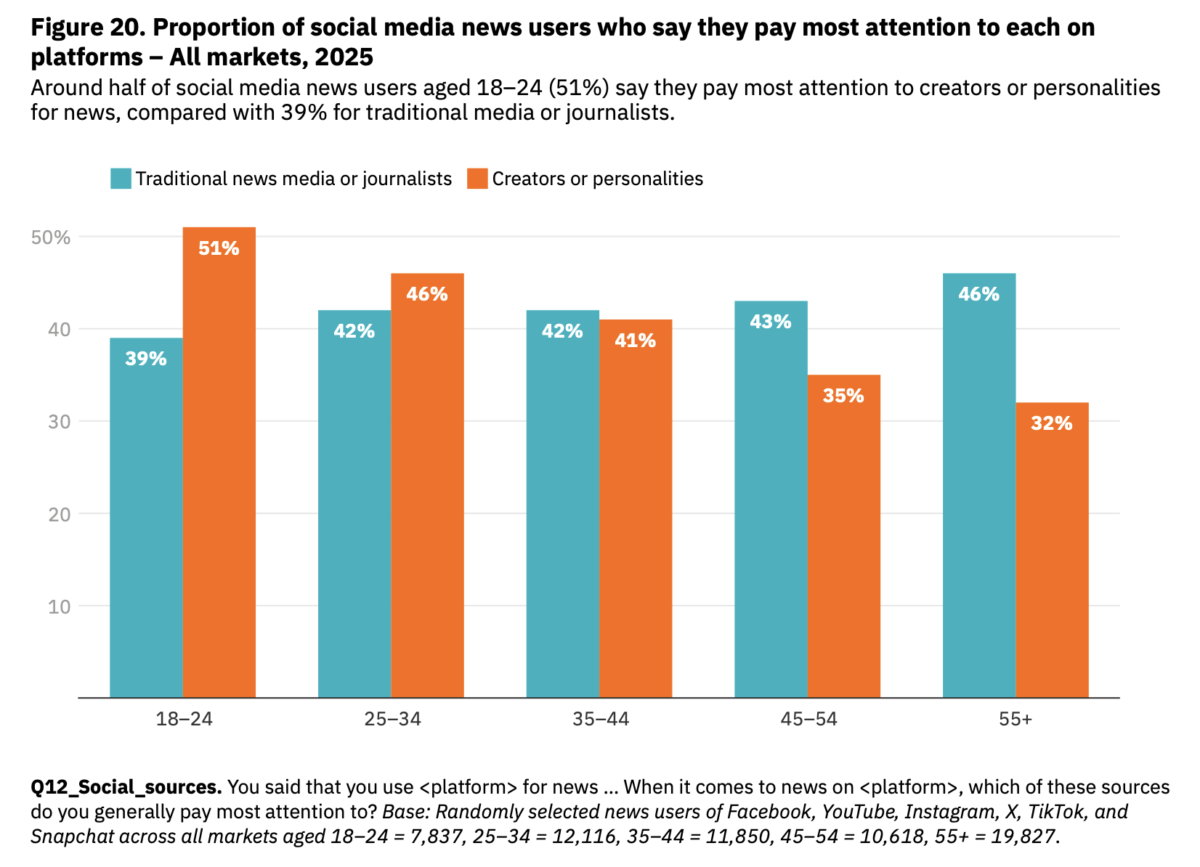
This shift reflects an obvious logic: what becomes available to everyone immediately becomes less attractive. Hyper-polished content lost its appeal the moment it became effortless to produce. Generations define themselves against what came before, and Gen Z is defining itself against algorithmic gloss and big media. The global creator economy, currently valued at USD 191.55 billion and expected to reach USD 528.39 billion by 2030, is increasingly rewarding those who embrace raw content and unpolished storytelling. Young people pay more attention to creators than traditional news media or journalists, helping them decrypt and decode traditional news.
This authenticity countermovement has a more radical edge too. Some people are choosing less content altogether. Sales of “dumb phones” designed to eliminate scrolling feeds are growing. Young people are embracing “Appstinence“. Nightclubs in several cities now confiscate smartphones at the door. Australia’s social media ban for under 16s is likely to inspire similar legislation across Europe and the world this year, despite lack of evidence over their effectiveness to protect kids from digital harm.
AI Search and the Collapse of Discovery
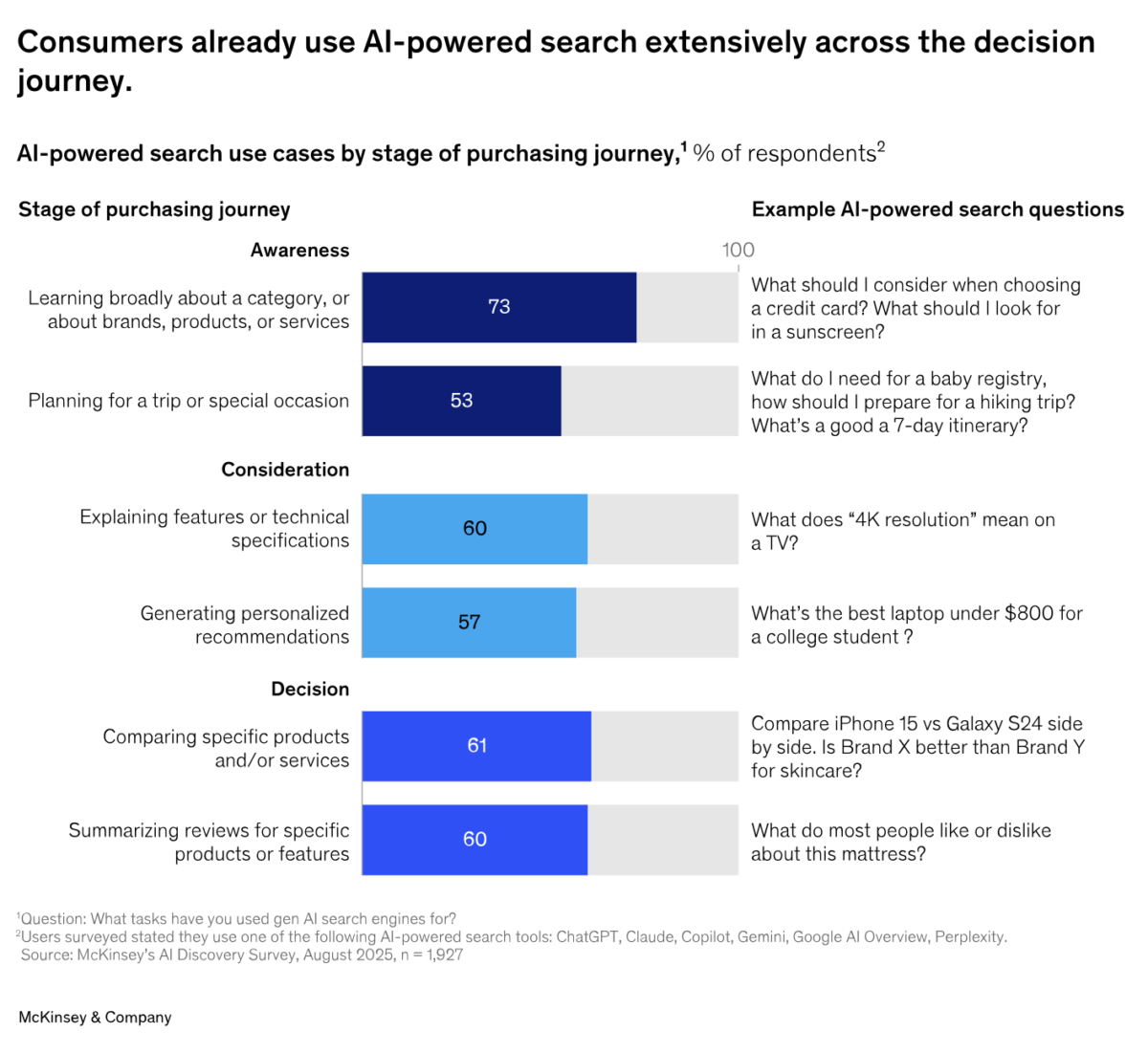
Publishers surveyed by the Reuters Institute expect traffic from search engines to decline by more than 40% over the next three years. Data confirms this is already underway: Google organic search traffic to over 2,500 news sites globally fell 33% between November 2024 and November 2025, as reported by Reuters. The culprit is primarily Google’s AI Overviews, answer boxes that appear at the top of search results and eliminate the need to click through to any source. McKinsey highlights that generative AI is replacing traditional search as the internet’s primary “front door,” requiring brands to pivot from Search Engine Optimisation (SEO) to Generative Engine Optimisation (GEO) to remain visible in an ecosystem where AI models prioritise third-party citations over a brand’s own website.
The response from publishers is instructive for anyone in communications: pivot from generic content to original, irreplaceable work. The Reuters survey shows executives believe the highest-value content in the AI era is original ground-level reporting, deep contextual analysis, and human stories, i.e. things that cannot be summarised into a chatbot response. Service journalism, evergreen content, and general news updates are being de-prioritised, because AI will deliver them more efficiently and at lower cost. For communicators and advocacy organisations, the implication is bigger than it might appear: if your content can be summarised in three bullet points by an AI, it probably will be, and your audience will never see the original.
Trust, Community, and Political Attacks on Journalism
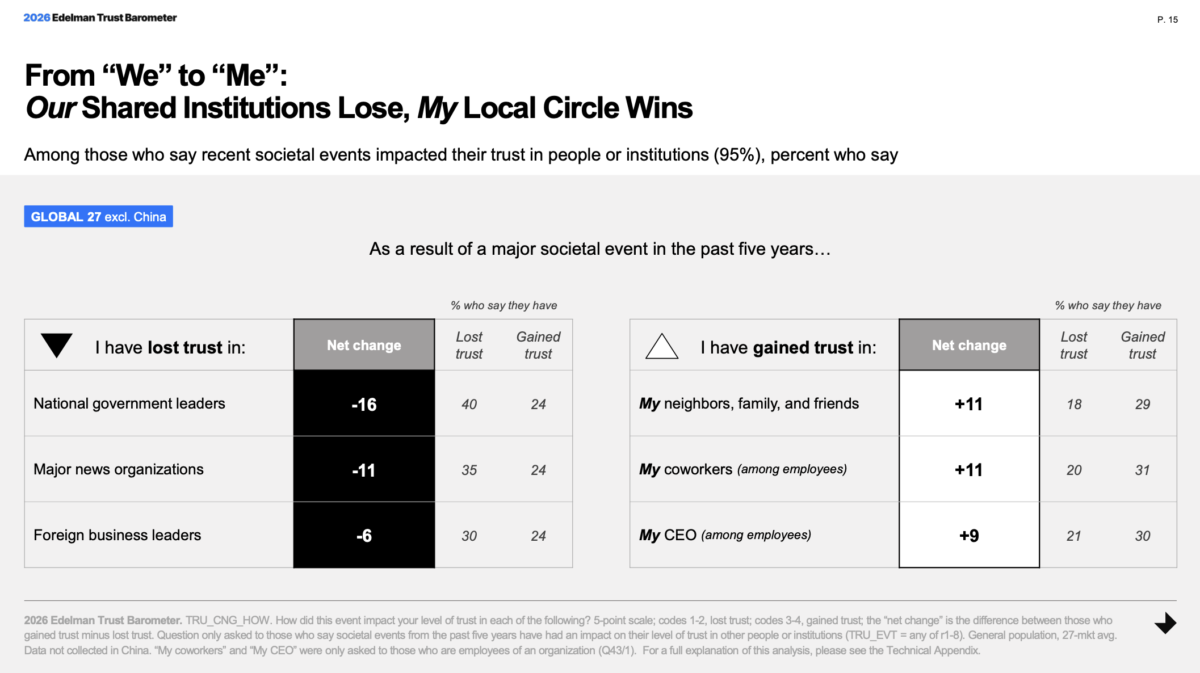
The 2026 Edelman Trust Barometer found that seven in ten people are unwilling or hesitant to trust someone with different values, information sources, or backgrounds. The trust gap between high and low-income groups has more than doubled since 2012. This is what Edelman calls “insularity”, a retreat into the safety of the familiar. Research published by the Complexity Science Hub provides the structural explanation: as social connectivity increases through smartphones and social media, political polarisation increases in parallel, with societies passing thresholds where diversity of opinions collapses into opposed camps. Economic anxiety and geopolitical instability accelerate this dynamic and retrenchment into extremes. Conspiracy beliefs exist because people need to understand their environment, feel safe in it, and maintain a positive image of their social group. This is all exacerbated in times of crisis.
But insularity doesn’t emerge in a vacuum. The Reuters Institute documents a coordinated political assault on the institutional infrastructure of shared information. Politicians across multiple continents have adopted a playbook of Orwellian information control, bypassing traditional media entirely, giving interviews to sympathetic podcasters, hosting their own YouTube channels, and using legal threats to intimidate journalists. US President Trump’s removal of Reuters and the Associated Press (two of the most trusted media) from the White House is but one example of this increased political grip over communications. RSF’s 2025 World Press Freedom Index found press freedom globally at its worst recorded level, partly driven by worsening economics that make news organisations more financially dependent on government or its allies.
This is the environment in which any message now has to travel. Trust in institutional sources is structurally eroding, not only because audiences are disengaged, but also because powerful actors have invested deliberately in eroding it. For organisations trying to communicate across lines of political difference, the message arrives pre-filtered through a legitimacy framework designed to dismiss it. Therefore, messages that travel through trusted community members now carry far more weight than messages broadcast from institutional channels. Successful communications in 2026 works through networks, not at audiences.
The Platform Paradox and Decentralisation
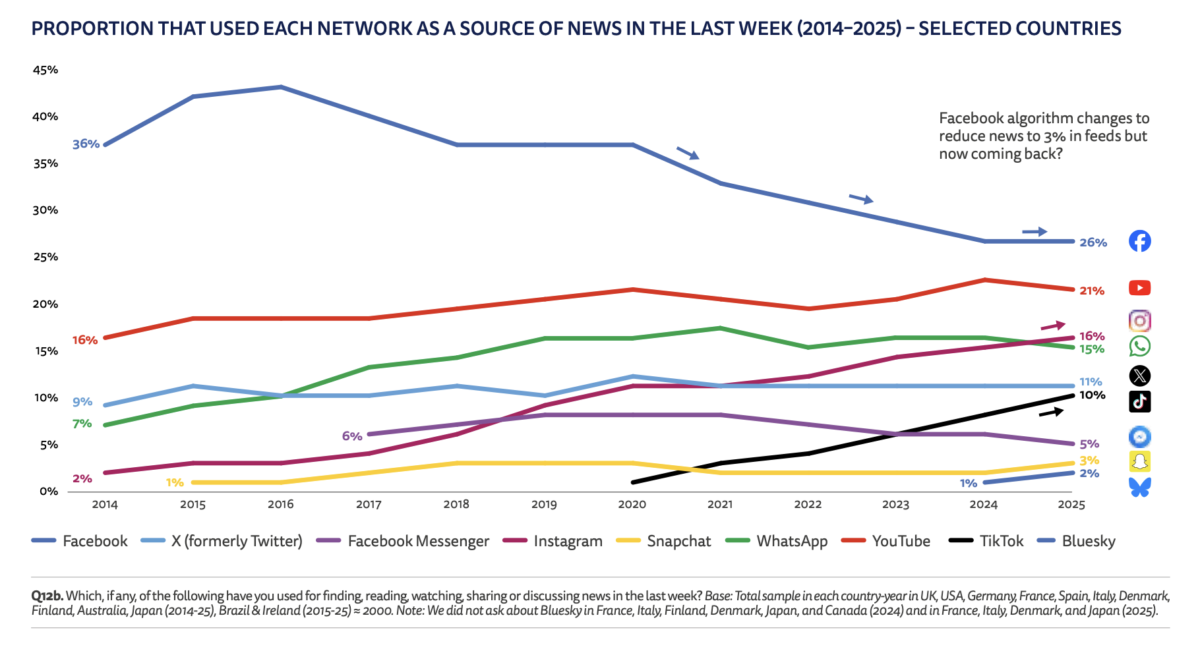
A paradox defines the current platform environment. While interest and trust in big tech is declining, social media presence remains essential for credibility and discovery, including for news media. As per the Reuters Institute 2025 Digital News Report, around a third of people globally use Facebook (36%) and YouTube (30%) for news each week. Instagram (19%) and WhatsApp (19%) are used by around a fifth, while TikTok (16%) remains ahead of X at 12%. Yet content creators and publishers are simultaneously retreating from dependence on these platforms, turning to self-owned sites and newsletters—particularly Substack, blogs, and podcasts—to build direct relationships with audiences they control. In sum: use social media for discovery; build the real relationship somewhere you own.
The decentralised media alternatives are also growing in user numbers: Bluesky has grown to over 42 million users as of February 2026. Mastodon has doubled its user base. Web3 platforms like Farcaster and Lens Protocol are demonstrating that blockchain-based social graphs can work at scale. A note of caution is warranted, however. The Reuters Institute survey shows publishers are actually deprioritising Bluesky this year. User numbers are growing, but institutional investment is not following. Bluesky’s audience skews toward journalists, researchers, and media professionals; it has not yet crossed into mass public engagement. The decentralised web is a legitimate long-term direction of travel, but it is not yet a reliable reach strategy for most communications objectives.
The platform that has slowly risen in strategic importance is LinkedIn (with a net score of +40 in publisher investment intentions), particularly for specialist and policy-oriented content. For organisations operating at the intersection of civil society, policy, and public affairs, LinkedIn may currently be underinvested relative to its actual audience reach.
Conclusion
Five forces are pulling the communications landscape apart at once, and they share a common logic: the rise of Artificial Intelligence (AI). The easier content becomes to produce, the less any individual piece of it is worth. The more platforms multiply, the harder it is to reach anyone reliably. The more institutions assert authority, the more audiences migrate toward people and networks they know and trust.
None of this is accidental nor temporary. The conditions have fundamentally changed: reach is fragmenting and institutional credibility is under constant scrutiny. Building something durable inside those conditions means becoming an architect of community rather than a factory of content, prioritising irreplaceable human insight and feelings, over easily summarised data.
The communicators who will matter in 2026 are the ones who understand they are operating inside a societal shift. Strategy follows from that recognition.

Hi! I’m Sophie
I am a social scientist and explorer. In my work, I analyse the intersection of politics, technology, and democracy. Nothing makes me happier than learning and discovering the wonders of the world. I consider myself an enthusiastic feminist and self-care advocate.