







Communications Consulting

You're not heard because you're not speaking to be understood.

My Approach

Icon representing continuous progress evaluation

Audience Research

Understanding who you are talking to, their language, their questions, and what makes them pay attention.

Icon representing a schedule

Strategic Planning

Building a communications practice with clear goals, deliberate sequencing, and a positioning that compounds over time.

Icon representing a fulfilled researcher

Purpose-driven

Everything we build is anchored in what you actually stand for. I’ll help you define and that and ensure it guides your action. 

Sophie L. Vériter, political scientist and consultant specialising in misinformation and European governance, offering academic consulting, admissions consulting, personal coaching, and communications consulting services

Nice to meet you, I’m Sophie

I am a political scientist, researcher, and writer who has spent a decade translating complex ideas for public audiences in peer-reviewed journals, at international conferences, and at sophiepomme.com, where over 9,000 monthly readers come for inspiration and analysis. 

What is Communications Consulting?

Communications consulting is a strategic advisory service that helps individuals and organisations develop a deliberate and coherent public voice. It is the upstream work defining what you stand for, who you are talking to, and how to turn your expertise into impact. 

In practice, this means working across the full spectrum of your communications, from the foundational strategic questions to the craft decisions that determine how your ideas land. Communications consulting covers:

Positioning

Positioning is the foundation of everything else in communications consulting. Before you write a single word for a public audience, you need a clear answer to a deceptively simple question: what do you stand for? Not what you work on, not your job title, but the distinctive perspective you bring that nobody else brings in quite the same way. Most people skip this step and go straight to producing content, and then wonder why it does not seem to add up to anything. Good positioning work identifies the thread that connects your expertise, your values, and your way of seeing the world, and turns it into a statement clear enough to guide every communications decision that follows.

Audience Strategy

You cannot communicate effectively without knowing who you are communicating with. Audience strategy is the discipline of getting specific — not “policymakers” or “the general public” but the particular people whose thinking you want to influence, what they already believe, what questions they are asking, and what kind of voice they are likely to trust. This requires research, empathy, and a willingness to let go of the assumption that your audience thinks the way you do. The most common mistake experts make is writing for people who already agree with them. Good audience strategy identifies the readers you most need to reach and builds a communications approach designed specifically for them.

Writing Development

Writing for public audiences is a distinct craft from academic or technical writing — and it is one that almost nobody teaches explicitly. The habits that make you a good scholar or analyst can actively work against you as a public writer: the hedging, the literature review instinct, the reluctance to make a strong claim without exhaustive qualification. Writing development in a communications consulting context means learning to lead with the argument, to write in a register your audience finds readable, and to make complex ideas accessible without dumbing them down. It is not about simplifying your thinking. It is about finding the form that lets your thinking travel further than it currently does.

Platform Strategy

Not every platform serves every communicator. Platform strategy is about making deliberate, evidence-based decisions about where to invest your communications energy — and, just as importantly, where not to. LinkedIn rewards a different kind of content than Substack. A personal website serves a different function than a policy brief. A newsletter builds a different kind of relationship with an audience than a thread on social media. Platform strategy begins with your goals — not with what everyone else in your field seems to be doing — and works backwards to identify the two or three channels that are most likely to reach your target audience and build the kind of presence you actually want over time.

Thought Leadership

Thought leadership is one of the most overused terms in communications — and one of the most underunderstood. It does not mean posting frequently or having strong opinions. It means having a point of view that is recognisably yours, consistently expressed across everything you publish, that over time makes you the person people turn to when they need to understand a particular set of questions. Building genuine thought leadership requires patience, strategic consistency, and a willingness to say something specific rather than something safe. It is a long game — but for researchers, writers, and experts whose credibility depends on intellectual reputation rather than visibility alone, it is almost always the right game to be playing.

Policy and Public Communication

Research that stays inside academia changes nothing. Policy and public communication is the discipline of translating rigorous expertise into formats that reach the people with the power to act on it — policymakers, practitioners, funders, journalists, and the informed public. This means policy briefs, op-eds, public commentary, and institutional communications that are substantive enough to be credible and accessible enough to be read. The challenge is not simplification — it is translation. The argument still needs to be rigorous. The evidence still needs to be accurate. But the structure, the register, and the relationship with the reader are fundamentally different from academic writing, and mastering that difference is what makes the difference between research that influences and research that sits on a shelf.

Institutional Communications

For organisations — research institutes, foundations, CSOs, think tanks, and public bodies — communications is not a secondary function. It is how your work reaches the people it is meant to serve and how your institution builds the credibility and visibility that makes everything else possible. Institutional communications consulting helps organisations develop a consistent, coherent public voice that accurately reflects their mission, speaks to their key audiences, and holds up across every channel and format they use. This includes editorial positioning, tone and voice guidelines, audience mapping, content strategy, and the governance questions around who speaks for the organisation, on what topics, and in what contexts. The goal is a communications practice that is sustainable, distinctive, and genuinely aligned with what the organisation is actually trying to achieve.

Services

I offer three categories of services designed to empower creatives and writers: 

icon of a target

strategy & positioning

The upstream work: figuring out what you stand for, who you are talking to, and what your communications should achieve. Delivered entirely through 1:1 sessions. This is where every engagement starts and where the most transformative work happens.

Icon representing academic paper feedback and review

content review

Hands-on written feedback on any communications asset such as op-eds, policy briefs, newsletters, website copy, LinkedIn content, or speaker bios. Delivered as document review, optionally combined with sessions.

icon of a system

presence-building

This is the long game. Website development, newsletter strategy, thought leadership architecture, content production, … combines sessions and production work over a longer engagement.

How it works

My academic consulting services always begin with a free scoping call (15 min) and a thorough intake consultation (90 min). Afterwards, we tailor a suite of services based on your needs . 

free scoping call

We discuss your situation, your communications goals, and your audiences. I tell you honestly whether and how I can help. No commitment required. Book here.

intake consultation

We map your positioning, assess your existing communications, identify gaps and opportunities, and build a strategic roadmap specific to you.

deployment

Strategic sessions, content production, and feedback, building your presence progressively with tools and frameworks you can use independently.

I prioritise researchers and writers from developing countries, marginalised communities, and low-income backgrounds in my work. If you identify or you think you may identify with this, please do ask about discounted prices and special offers. 

Pricing

Every engagement begins with a free 15-minute scoping call, followed by a flat-rate intake consultation (90 min, 200€). From there, my communications consulting is billed at a single rate of 120€/hour and will be invoiced monthly. 

  • First scoping call (15 min) — free
  • Intake consultation (90 min) — 200€ flat rate 
  • All subsequent work — 120€/hour
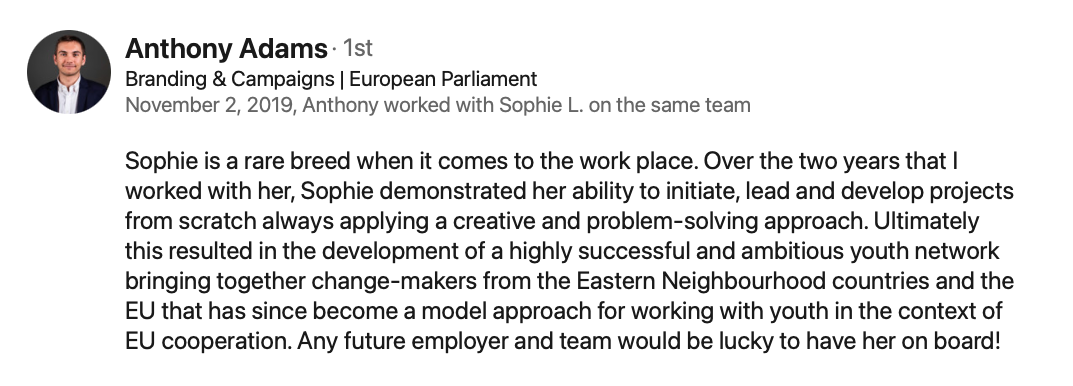
A recommendation tha reads: " Anthony Adams · 1st Branding & Campaigns | European Parliament November 2, 2019, Anthony worked with Sophie L. on the same team Sophie is a rare breed when it comes to the work place. Over the two years that I worked with her, Sophie demonstrated her ability to initiate, lead and develop projects from scratch always applying a creative and problem-solving approach. Ultimately this resulted in the development of a highly successful and ambitious youth network bringing together change-makers from the Eastern Neighbourhood countries and the EU that has since become a model approach for working with youth in the context of EU cooperation. Any future employer and team would be lucky to have her on board!"

Frequent Questions

What is a communications consultant?

A communications consultant is a strategic advisor who helps individuals and organisations develop a clear, deliberate public voice. Unlike a copywriter who produces content on your behalf, a community manager to handle your daily platform interactions, or a PR professional who manages media relationships, a communications consultant works upstream, on the foundational questions of positioning, audience, and strategy that determine what you say, how you say it, and where. The goal is better, more targeted communication that is coherent and genuinely aligned with what you are trying to achieve. A good communications consultant will change how you think about communicating altogether.


What does a communications consultant do?

A communications consultant advises on the full spectrum of public communication, from strategic positioning and audience research to writing development, platform strategy, and thought leadership. In my practice, this can mean helping a researcher learn to write for policy audiences, helping a creative professional articulate what makes their work distinctive, helping an NGO develop a coherent institutional voice, or helping an academic build a newsletter that people will actually read. The specific work varies enormously by client but what stays constant is the strategic frame: every piece of communication should serve a clear purpose, reach a defined audience, and reflect a coherent point of view.

How much does a communications consultant cost?

Communications consulting rates vary significantly depending on the consultant’s expertise, location, and the scope of the work. Senior strategic consultants with specialist expertise, particularly in complex fields like policy, academia, or institutional communications, typically charge €100–200 per hour. My rate is €120 per hour for all work, including strategic sessions, document review, and content production. Every engagement begins with a free 15-minute scoping call and a flat-rate intake consultation of €200 for 90 minutes. 

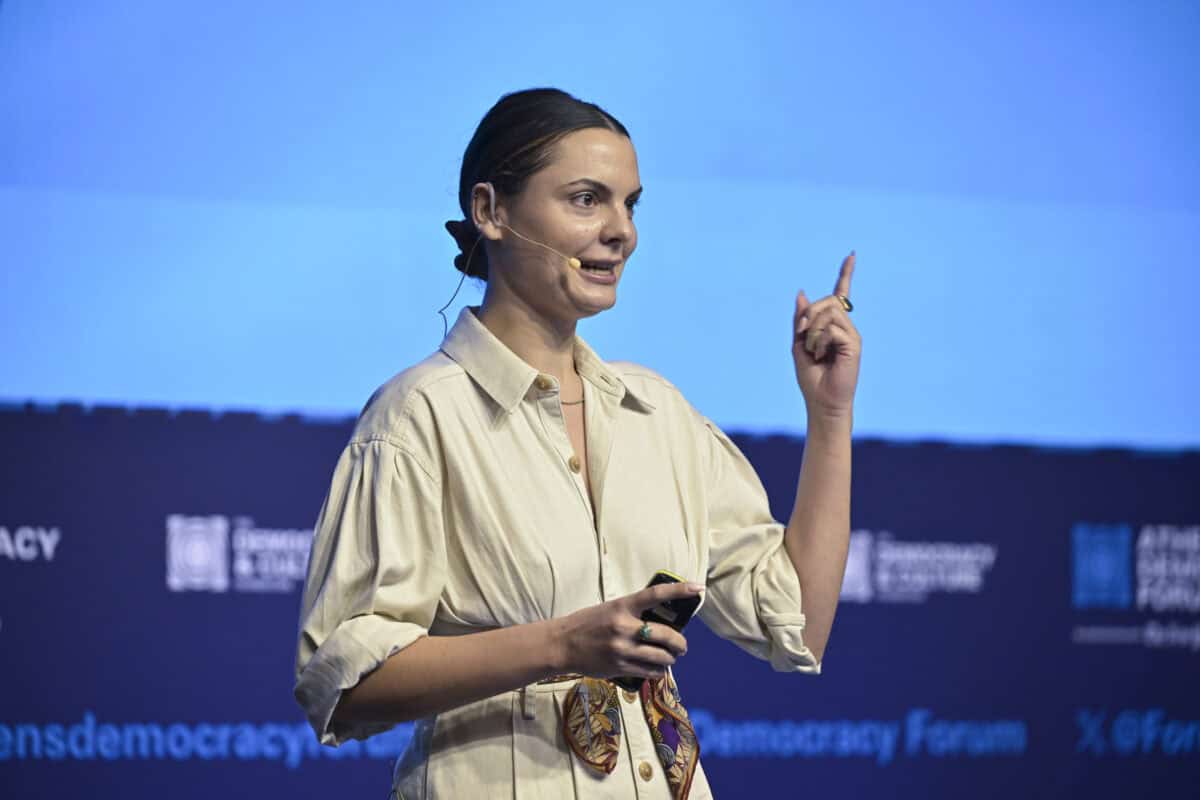
Sophie Vériter speaking on stage at the Athens Democracy Forum

My personal experience

am a political scientist, researcher, and writer based in The Hague. I hold an MPhil from Oxford and a PhD from Leiden, and have spent a decade advising governments and European institutions on strategic communications and information policy. I created the Young European Ambassadors initiative for the European Commission (now active across 34 countries with 2,500+ members). I am the Founding Director of the Global Society Foundation and have spoken at over 200 international events. I write publicly at sophiepomme.com, where I have built a readership of 9,000 monthly readers. I know what it takes to make rigorous thinking reach the people who need it because I do it myself, constantly.

Do you need a communications consultant?

You probably need a communications consultant if you have something genuinely worth communicating but are not reaching the audiences you want to reach or if you are producing content that does not seem to add up to a coherent identity over time. You also need one if you are at a transition point: moving from academia into public life, launching a new website, repositioning professionally, or trying to build influence in a new space. What a communications consultant will not do is fix a communications problem that is actually a strategy problem, which is why the first thing we establish together is whether your challenge is one I can meaningfully help with.

How do I develop a communications strategy?

A communications strategy starts with three questions: what do you want to be known for, who do you want to reach, and what do you want them to think or do differently after encountering your work? Everything else (which platforms, how often, in what format) follows from the answers to those questions. A strategy is a living framework for making consistent decisions over time. Done well, it makes every subsequent communications decision easier because you know what you stand for and who you are talking to.

Where are you based and do you work with international clients?

I am based in The Hague, Netherlands, and work with clients from all over the world. My client base spans researchers and academics at European and international institutions, policy professionals and civil society organisations across the EU and beyond, creative writers and independent professionals in multiple countries, and public institutions navigating complex communications challenges. All consultations are conducted online, which means geography is no barrier. The only thing that matters is whether we are a good fit, which is exactly what the free scoping call is designed to establish.

What is strategic communications consulting?

Strategic communications consulting focuses on the big-picture questions behind everything a person or organisation communicates. It begins with positioning: what do you stand for and what makes your perspective distinctive? It moves through audience strategy: who are you trying to reach and what do they need from you? And it ends with a coherent plan for how all your communications across every channel and format work together to build credibility, trust, and influence over time. Strategic communications consulting is particularly valuable for researchers, policy professionals, and institutional clients navigating complex environments where credibility is hard-won and easy to lose.

What is the difference between PR and communications consulting?

PR manages your relationship with the media, it is reactive, campaign-driven, and focused on coverage, reputation, and press relationships. Communications consulting is broader and more strategic: it focuses on your overall public voice, your positioning, your writing practice, and how everything you put into the world adds up to a coherent identity over time. PR asks: how do we get coverage for this? Communications consulting asks: what do we stand for, who are we talking to, and is everything we communicate actually saying that? The two can work together but they are different disciplines serving different needs.

What is the difference between a communications consultant and a copywriter?

A copywriter produces content, in other words they write on your behalf to a brief. A communications consultant works ahead of content production, on the strategic questions that determine what the brief should be in the first place. Many clients discover that once the strategic foundations are in place (clear positioning, defined audience, coherent voice), their own writing improves dramatically and the copywriter’s job becomes much easier. I do produce content for clients as part of longer engagements, but always within a strategic framework we have built together. Content without strategy is noise; strategy without execution is just a document. Both are essential, in the right order.

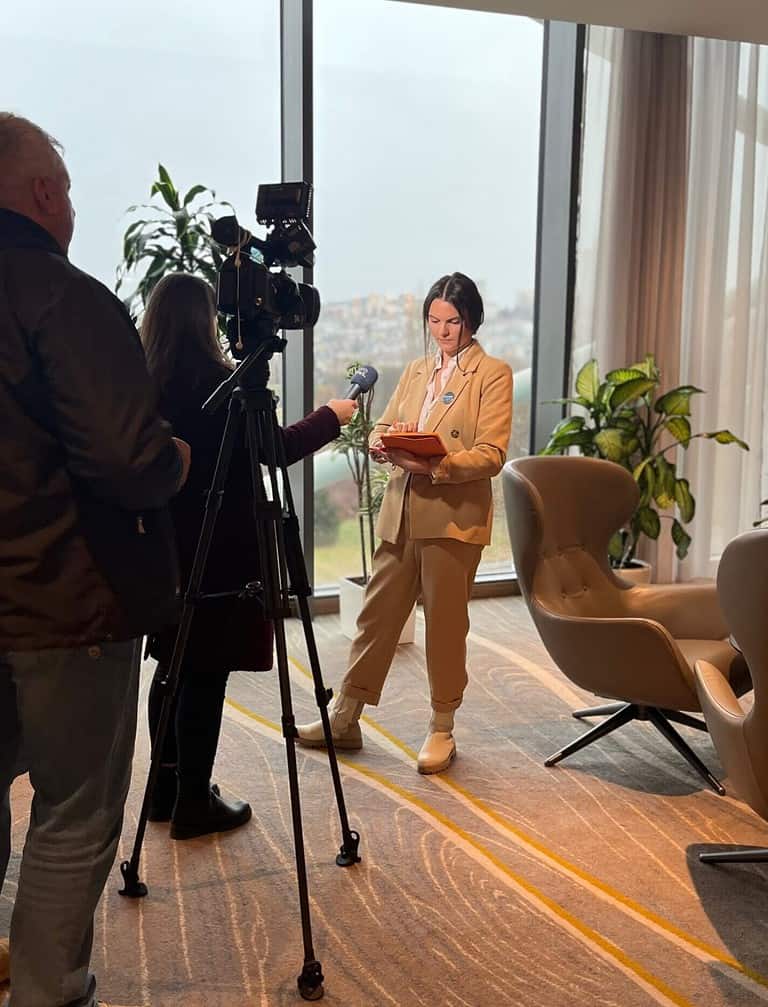
Sophie Veriter being interviewed for Euronews

Free Tools for Growth

Discover free apps, books, websites, and YouTube channels  to help you on your journey to success in my Growth Toolkit. It is a collection of resources to start or enhance your personal and professional growth journey whilst keeping your wellness in check, boosting confidence and critical thinking, as well as continuously expanding your skills and knowledge.

Communications Consulting for Researchers

How do I build a personal brand as a researcher or academic?

Building a personal brand as a researcher starts with one honest question: what do you want to be known for, and by whom? Not your job title or your institution but the specific perspective you bring that nobody else brings in quite the same way. From there, it is about choosing one or two platforms where your target audience actually spends time, showing up there consistently with content that reflects that perspective, and making it easy for the right people to find and follow you. The most common mistake academics make is trying to be visible everywhere. The most effective researchers build deep credibility in one or two places first.

How do I write for a non-academic audience?

Writing for non-academic audiences requires genuinely unlearning some of the habits that make you a good scholar. Lead with the argument, not the literature. Use short sentences. Make your claim in the first paragraph and spend the rest of the piece defending it, not building up to it. Lose the hedging. Cut the jargon where a plain word exists. Write to a specific person, not to a generic reader. None of this means abandoning intellectual rigour. Rather, it calls for finding the form that lets your rigour travel further. 

What is thought leadership and how do I build it?

Thought leadership means having a distinctive point of view on a set of questions that matter to your field and expressing it consistently enough over time that people begin to associate that perspective with you specifically. It is not about posting frequently or having strong opinions. It is about standing for something specific, building a body of work around it, and showing up reliably enough that your audience knows what to expect from you. Building genuine thought leadership takes twelve to twenty-four months of consistent effort. The clients who get there fastest are those who start with the clearest answer to the question: what do I actually think that most people in my field do not?

How do I grow a newsletter or Substack?

Growing a newsletter starts before the first issue, with a clear answer to why this newsletter exists and why someone would choose it over the dozens of others in their inbox. Positioning is everything. Once that is clear, growth comes from three things: consistent quality that gives readers a genuine reason to return, deliberate distribution that puts each issue in front of new potential readers, and a writing voice distinctive enough to be recognisable and worth recommending. Vanity metrics like subscriber count matter far less than engagement. A newsletter with 500 loyal readers who open every issue is more valuable than one with 5,000 who never do.

How do I get my research noticed outside academia?

Getting your research noticed outside academia requires translating it, not simplifying it. The question you must find an answer to is “who needs to know this, and what format do they actually read?” Policymakers read one-page briefs and op-eds. Journalists read press releases and are moved by a single compelling angle. Practitioners read case studies and implementation guides. The intellectual content can stay rigorous but the format, the frame, and the opening sentence need to be built for the audience, not for a peer reviewer. Start with one audience, one format, and one clear claim. Then build from there.

Sophie L. Vériter, academic consultant and personal coach

Your journey starts here

I offer on-on-one coaching services to individuals who seek to adopt the mindset that will help them achieve their full potential. Interested? Book a free 15-min consultation with me!

Academic Coaching • Goals Setting • Planning • Career Advice • CV feedback • Personal Growth • Productivity

Subscribe

for a monthly round-up of the latest advances in technology and global affairs, tips to thrive in academia, resources to support your personal growth, and more!

Latest Blog Posts

Subscribe

Receive my latest articles, what I’m currently reading and listening to, and my favourite resources directly in your mailbox, once a month.