



EU–China Relations in the Age of AI: Volatile Rivalry and Cooperation

EU–China relations are marked by long-term structural rivalry but also by immediate geopolitical flashpoints. Domestically, China has grown more authoritarian and nationalistic over the past decade, while externally it projects assertiveness in its region and beyond. Relations with the US, EU, and many neighbours have soured, and Beijing’s alignment with Moscow after Russia’s invasion of Ukraine has reinforced Europe’s perception of China as a systemic rival.

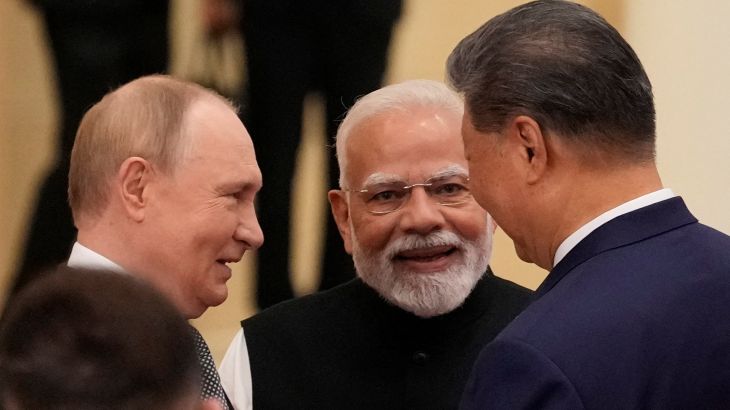
Indian Prime Minister Narendra Modi talks with Russian President Vladimir Putin and Chinese President Xi Jinping.Xi, Putin and Modi pledge unity at summit to counter US-led global order
Indian Prime Minister Narendra Modi talks with Russian President Vladimir Putin and Chinese President Xi Jinping (Al Jazeera)

Recent events underscore this trajectory. At the Shanghai Cooperation Organisation (SCO) summit in Tianjin (August–September 2025), Presidents Xi and Putin pledged to accelerate a “new global order” resisting Western “hegemonism.” Beijing announced fresh grants and loans to SCO members and floated a new Global Governance Initiative, linking political rhetoric with economic incentives. The summit’s symbolism was reinforced days later by China’s military parade, where advanced drones, hypersonic missiles, and AI-enabled systems were showcased as emblems of growing military-technological power. Together, these moves highlight Beijing’s ambition to combine ideological appeal, financial statecraft, and hard power to contest the liberal order. With the power vacuum created on the global scene by US President’s “America First” policies, China is seizing the opportunity of a century to reclaim its position as a leader.

For the EU, this creates a threefold challenge:

First, managing economic interdependence: China remains a key trade partner, yet unfair practices, lack of reciprocity, and technological rivalry fuel calls for resilience. Hence the EU’s de-risking strategy, supported by tools such as the Chips ActCritical Raw Materials Act, and Anti-Coercion Instrument.

Second, handling security and human rights risks: Beijing’s stance on Taiwan, its deepening ties with Moscow, and its human rights record (Xinjiang, Hong Kong) keep EU–China relations under strain. The Chinese approach to AI applications, with large-scale personal data collection, contrasts with European norms. Peace in Ukraine today largely depends on China’s will.

Third, shaping the global battle of narratives: in the Global South (or Global Majority, as many now say), China positions itself as a champion of neutrality, sovereignty, and development, while the EU struggles to project a convincing and credible alternative. At the UN, China has been solidifying its influence in all aspects of rule-setting. 

In AI and other dual-use technologies, securitisation pressures are rising. Treating AI as a security matter enables rapid protective action but risks bypassing democratic oversight, deepening the EU’s legitimacy gap. To remain credible, Europe must combine resilience at home and abroad: investing in industrial capacity, setting international standards, facilitating compliance, but also projecting a compelling narrative and fostering public engagement in the European approach to AI, while sustaining literacy on the topic. In that sense, the EU’s “AI Continent Action Plan” falls short of offering a package that connects with its full target audience — investors, technical experts, and the public. 

Without a comprehensive long-term strategy, the EU risks continuing to be portrayed as reactive and fragmented. With an AI policy involving standard-setting, industrial investment, and strategic communications, it could balance rivalry and cooperation, protecting its sovereignty while engaging China in areas of global necessity such as climate change, development, and technological governance. But make no mistake, it will require considerable investment to restore the credibility and image of the EU in the eyes of the public, which has been massively disappointed through repeated crises and humiliations that have damaged public trust and understanding. The investment that China puts into conveying its vision of a multipolar world led by China must be matched by an equally persuasive European strategic narrative.

Further Resources

The European Commission's AI Continent Action Plan

The European Parliament's study on EU-China relations

The European Commission's EU-China Strategy

A woman with sunglasses taking a selfie for Instagram on a charming street of Oslo.

Hi! I’m Sophie

I am a social scientist and explorer. In my work, I analyse the intersection of politics, technology, and democracy. Nothing makes me happier than learning and discovering the wonders of the world. I consider myself an enthusiastic feminist and self-care advocate.

Share:

Email
WhatsApp
X
LinkedIn
Pinterest

Related Posts