Applying to Oxford is a transformative experience, regardless of the outcome. Having applied to multiple programmes at Oxford University myself, gotten accepted in both Master of Philosophy (MPhil) and Doctor of Philosophy (DPhil) programmes, and helped dozens of students get in their dream course, I know what Oxford admissions committee look for. Many applicants approach the admissions process with a combination of excitement and anxiety, unsure where to start and what truly makes a difference.
Since I graduated from Oxford in 2020, I have helped numerous students navigate the admissions process, from researching the right programmes to helping them craft their personal statement and preparing for interviews. The Oxford acceptance rate among my clients sits above 70%. What I have learned, both from my own experience and from working with applicants, is that the process is demanding but navigable. The difference between successful and unsuccessful applications is almost always about preparation, strategy, and quality of writing.
This guide covers what you actually need to know about Oxford admissions: the requirements, the acceptance rates, the process, and the parts that most prospective students get wrong.
What Is the Oxford Admissions Rate?
Let’s start with the number everyone wants to know. Oxford’s overall acceptance rate sits at around 17%, significantly higher than US Ivy League schools, but this figure conceals enormous variation by subject. Medicine and some sciences accept fewer than 10% of applicants, while other subjects accept 25-35%. For graduate programmes, the picture is similar. Graduate acceptance rates vary by course but average around 27%, though highly competitive programmes such as Computer Science, Politics, and Medicine can fall well below 10%.
Two things are worth understanding about these numbers. First, Oxford’s acceptance rate has remained relatively stable year to year, with variations driven more by changes in application volume than by major shifts in admissions policy. Second, the overall rate is almost meaningless for your specific situation. What matters is the acceptance rate for your subject, your level of study, and your applicant pool. A 17% headline figure tells you very little about your chances of getting onto the MSc in Social Science of the Internet or the MPhil in International Relations. The only useful benchmark is the one specific to your course and that information is available on Oxford’s own course pages, which publish data on applications and places offered each year.
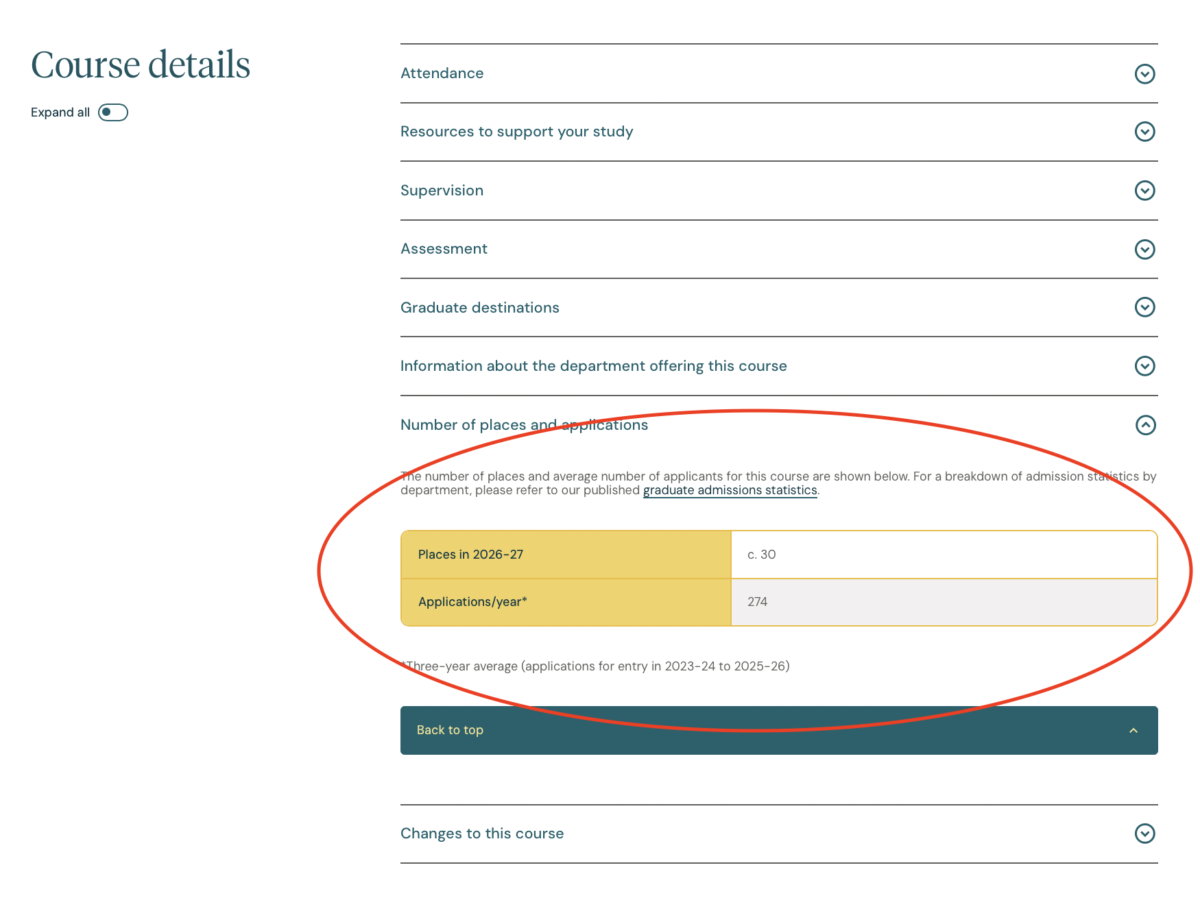
Each course page contains details about their admissions rate. For example, this is the information available for the MPhil in International Relations at the Oxford Department of Politics and International Relations. They offer, on average, 30 places per year. They receive, on average, 274 applications per year. The admissions rate for the programme is therefore approximately 11%, making it nearly twice as competitive as Oxford’s overall figure suggests. In comparison, the MPhil in European Politics and Society at the same department has an average admission rate of 24%. This illustrates the importance of researching the various programmes that match your interests and make a strategic choice balancing fit and competition.
Oxford Admissions Requirements
Oxford admissions requirements vary significantly by programme, and the single most important piece of advice is to read your specific course page carefully and in full. What follows is an accurate overview, but it is not a substitute for the authoritative information Oxford publishes itself. You can find the specific requirements for each course on the undergraduate and postgraduate courses list.
Academic requirements
For undergraduate applications, Oxford typically requires A-levels at A*AA or AAA depending on the course, or equivalent qualifications. For US high school students, this generally means a GPA of 3.7 or above alongside SAT scores of 1500+ or ACT scores of 34+, though requirements vary by course and the equivalent standards for your specific qualifications are published on each course page. Graduate programmes generally require a professional bachelor’s degree from a recognised institution, and most programmes look for the equivalent of a strong UK upper second-class degree (2:1) or above, roughly equivalent to a GPA of 3.5 or higher on a 4.0 scale for US applicants.
English language requirements
For most Oxford graduate programmes, the IELTS requirement is 7.5 overall with no skill below 7.0. Some programmes set higher thresholds. Students who completed their previous degree entirely in English at an institution in an English-speaking country may be exempt from the language requirement but exemptions are not automatic and must be confirmed on your specific course page, which remains the authoritative source. You may have to submit an English test waiver request.
Supporting documents
Most graduate courses require a personal statement or a statement of purpose. Some programmes, particularly research-focused ones, may instead require a research proposal, and in some cases applicants must submit both. Beyond the personal statement, you will typically need to provide academic transcripts, two or three academic references, and in many cases a CV, often filled directly in the online application form. Some programmes require a writing sample or portfolio.
Oxford is strict about document requirements. If your supporting documents significantly differ from the specifications, for example by exceeding the word limit, they may be removed from your application, which will then be considered incomplete and is unlikely to be assessed. This is not a technicality to take lightly.
Admissions tests
For undergraduate applicants especially, preparing specifically for your subject’s admissions test, the MAT (Mathematics), PAT (Physics), LNAT (Law), or TSA (Thinking Skills Assessment for PPE, Philosophy, and some other subjects), is a critical filter before interviews. Past papers and specialist preparation are essential. US students should note that SAT and ACT scores are not a substitute for these subject-specific tests; they are separate requirements and must be sat regardless of your existing standardised test results. Graduate programmes less commonly require admissions tests, but some do. As always, heck your course page.
Interviews
If you are shortlisted, you may be invited to interview. Interviews are common for undergraduate programmes, but less common for postgraduate ones. Interviews are conducted by academics who teach and research at Oxford. They are your chance to show your enthusiasm for your subject and to demonstrate your ability to think carefully about challenging topics.
Oxford interviews are not a test about what you know; they are designed to assess how you think. Tutors want to see how you respond to unfamiliar problems, how you reason through uncertainty, and whether your intellectual curiosity is genuine rather than performed. Preparation means practising thinking aloud, engaging with challenging material in your subject area, and being willing to be pushed further than your prepared answers take you.

Hi! I’m Sophie
I am a social scientist and consultant. In my work, I analyse the intersection of politics, technology, and democracy. Nothing makes me happier than learning and discovering the wonders of the world. I consider myself an enthusiastic feminist and self-care advocate.
The Personal Statement: What Oxford Actually Looks For
The Oxford personal statement should not be treated as a list of achievements. It should be seen as an argument, a story explaining why you are intellectually ready for this programme, why it is right for you, and what you will bring to it. The most common mistake applicants make is writing a statement that is impressive but generic: a chronological tour through their career, ending with a paragraph about why Oxford is wonderful. Admissions tutors read thousands of these. They are looking for something different.
Oxford admissions tutors prefer honesty over exaggeration, and statements without specific examples or clear motivation tend to be weaker. What distinguishes a strong personal statement is specificity: detailed intellectual interests, precise questions you want to pursue, specific ways in which your background has prepared you for graduate-level work in this subject. The statement should be focused, analytical, and written in a voice that is unmistakably yours.
One further note: Oxford warns that plagiarism checks may be used, and the use of AI tools to generate or heavily draft the content is highly discouraged and generally frowned upon. The statement must be entirely your own work. The personal statement is one of the few places in the application where your own thinking and writing cannot be substituted.
Where to Find the Information That Matters
Almost everything you need is on Oxford’s own website, and it is more detailed and more reliable than any third-party guide, including this one.
The two places to start:
Your specific course page. Find the course of your choice on the list of undergraduate and postgraduate programmes. This is the authoritative source for entry requirements, application components, word limits, deadlines, and selection criteria. Read it carefully and read it more than once. The requirements differ between programmes in ways that catch applicants by surprise.
The Ultimate Guide to Crafting a Winning Oxford Application. For a deeper dive into every stage of the application, I have put together a comprehensive step-by-step guide, The Ultimate Guide to Crafting a Winning Oxford Application, drawing on my own experience as an Oxford MPhil and DPhil admit, as well as years of supporting students through the process. It covers everything from choosing the right programme and approaching your personal statement to preparing for the interview and understanding what world-leading universities are really looking for. If you are serious about your application, it is the place to start.
My Approach: Oxford Admissions Consulting
I offer 1-1 admissions consulting for students applying to competitive graduate programmes at Oxford, Cambridge, LSE, and beyond. Having gone through the Oxford process myself, and having supported numerous applicants through it since, I know where the real work is, what admissions committees look for, and where most applications fall short. The Oxford acceptance rate among my clients sits above 70%, a figure I am proud of, and one that reflects how much preparation and positioning matter in a process this competitive.
The support I offer is tailored entirely to your application. It typically includes:
- Programme research and strategy: Identifying the right course, assessing your competitiveness, understanding the specific requirements, and making a plan that gives you the best chance of a strong application.
- Personal statement and statement of purpose development: This is where I spend the most time with applicants. From early drafts to final version, I work with you to develop a statement that is rigorous, specific, and written in a voice that is genuinely yours. I do not write your statement for you, I help you write it better than you could alone.
- Research proposal support: For DPhil and research master’s applicants, the research proposal is often the highest-stakes document in the application. I help you frame your research question, situate it in the relevant literature, pick the right methodology, and articulate why Oxford is the right place to pursue it.
- Interview preparation: Oxford interviews are unlike most interviews you will have experienced. I work with applicants on the specific skills they require: thinking aloud, engaging with unfamiliar problems, and sustaining an intellectual conversation under pressure.
All engagements begin with a free discovery conversation to understand where you are in the process and where support would be most useful.

Let's dive in together!
I would love to accompany you on your writing journey. Together, we’ll define your goals and find the words to express them with clarity and confidence.
My approach builds on a decade of writing, researching, and publishing across academia, policy, and the media, working alongside ambitious individuals who have something important to say and want to say it well.
FAQ: Oxford Admissions
What is the Oxford admissions rate for graduate students?
Graduate acceptance rates average around 27% across all programmes, but vary enormously by course. Research programmes and highly competitive taught degrees can have rates well below 10%. The most reliable source for your specific programme is the course statistics published on Oxford’s own website.
What grades do I need for Oxford graduate admissions?
Most programmes require the equivalent of a strong UK upper second-class degree (2:1) at minimum, with many competitive programmes expecting first-class or distinction-level performance. The specific requirement is published on your course page. A strong academic record is necessary but not sufficient: the personal statement, references, and research proposal matter enormously.
When is the Oxford admissions deadline?
Undergraduate applications close on 15 October each year via UCAS. For graduate programmes, most deadlines fall in between December and March, though some programmes have earlier deadlines for scholarship consideration. Always check your specific course page: deadlines vary, and missing a scholarship deadline has consequences even if the application deadline is later.
Do I need to contact a supervisor before applying to Oxford?
For most DPhil and research master’s programmes, yes. Identifying a potential supervisor who is willing to work with you is typically a prerequisite for a competitive application. For taught master’s programmes, it is generally not required, but making contact with faculty whose work relates to yours can strengthen your application.
How important is the Oxford personal statement?
It is the single most important document in most applications. It is the place where Oxford assesses your intellectual preparation, your motivation, and your fit for the programme. Strong academic records are common among applicants, but a genuinely excellent personal statement is not. It is where most applications are differentiated.
How should I prepare for an Oxford interview?
Practice thinking aloud and reasoning through unfamiliar problems in your subject area. Revisit your personal statement and be prepared to discuss anything in it in depth. Read widely in your subject beyond your formal coursework. The interviewers are not trying to trick you, they are assessing whether you can engage seriously with challenging ideas. The best preparation is genuine intellectual engagement with your field.
Can an admissions consultant help with my Oxford application?
Yes, and the right consultant can make a significant difference at the personal statement and research proposal stage especially. Among my own clients, the Oxford acceptance rate sits above 70%, well above the programme averages, which reflects what targeted, personalised support can do at the margin. What to look for: someone with direct experience of the Oxford process, knowledge of your subject area, and an approach that develops your application rather than replacing your voice with theirs. The statement must be yours; the best consultants help you make it better, not different.
Where can I find the most accurate Oxford admissions information?
Always start with Oxford’s own website: your specific course page for requirements, and the Graduate Application Guide for the mechanics of applying. Third-party guides, including this one, are useful for context and orientation, but the course page is the authoritative source and requirements do change from year to year.