Unless you’ve been living under a rock, you heard of prediction markets and of the controversies linked to insiders who made profits on wars and other state affairs usually falling within the remit of “national security”. I have always been interested in the meaning of security, and critical of labelling something as a “security” issue, because it usually obstructs public oversight. I wrote my entire PhD thesis on the phenomenon of “misinformation”, on how states and institutions construct and manage information environments, and who benefits from controlling them. Prediction markets represent a different kind of epistemic infrastructure: decentralised, financially incentivised, and largely outside state control. That contrast is what drew me in. When I heard that a so-called “information market” running on Polygon was labelled a “truth machine”, I knew I had to dive deeper. Prediction markets are considered more accurate than expert opinion or polling, in some cases, because they impose a financial cost on overconfidence. So, could prediction markets offer public value? In this essay, I unpack what prediction markets are and are not, why they could be useful for democracy, and what it requires to be successful.
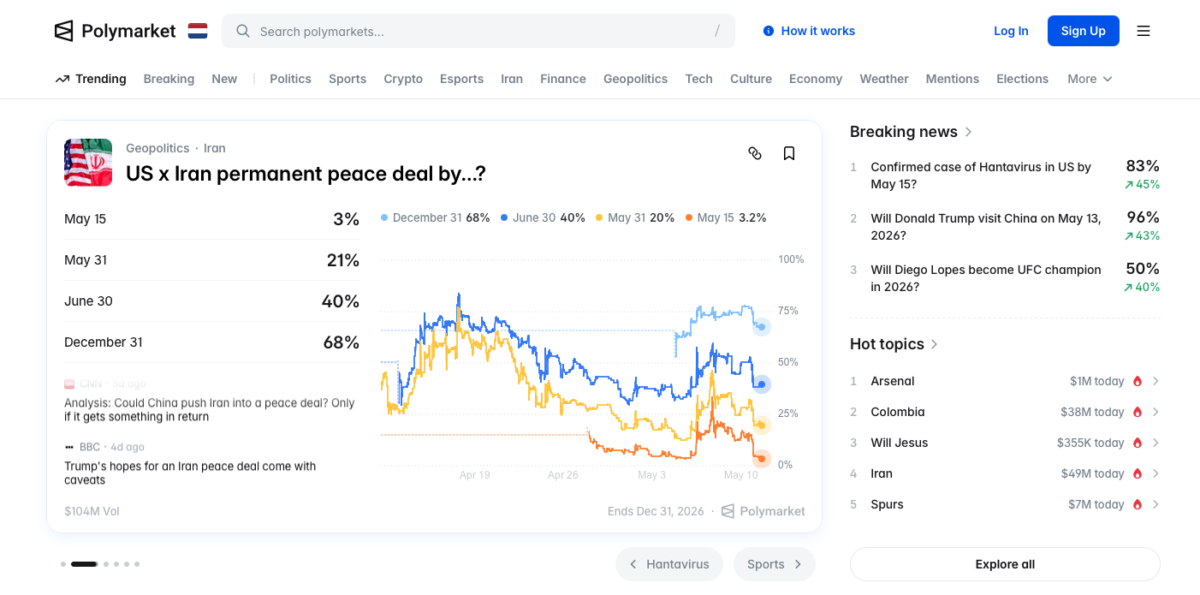
What are prediction markets?
Prediction markets, like Polymarket, Kalshi, or Predictit, are platforms where people buy and sell shares tied to the outcomes of future events, from elections and economic indicators to geopolitical developments, with prices fluctuating in real time to reflect the crowd’s collective probability estimates. Originally theorised by economist Robin Hanson under the name “idea futures”, they have existed as an academic concept since the early 1990s. What changed recently is scale, liquidity, and visibility.
Recently, prediction markets have made headlines because of insider trading scandals that showed the hidden economics of security. In the United States, Army soldier Gannon Van Dyke was charged in April 2026 with using classified knowledge of the covert mission to capture Venezuelan President Nicolás Maduro to place bets on Polymarket days before the operation, netting roughly $400,000 in profits from a $33,000 stake. The case is not isolated. Israeli authorities separately arrested several people and indicted a civilian and a military reservist on suspicion of using classified information to place bets about Israeli military operations on Polymarket.
Ethical questions reached a new milestone when Polymarket pulled markets allowing users to bet on the probability of a nuclear weapon being detonated before a certain date. Online backlash forced the platform to confront the obvious: monetising the prospect of nuclear war may create financial incentives for those in power to make it happen. When those events are high-stake security events, they create particularly strong information asymmetry and advantage.
What these cases collectively expose is a two-tiered information governance failure. On the one hand, a lack of safety rules that prevent the monetisation of catastrophic events such as nuclear war. On the other, an enforcement gap that allows specific “security” actors to benefit from obscurity and information asymmetry. Any serious democratic use case for these platforms requires addressing them directly.
What prediction markets are not: myths and reality
The “truth machine” label deserves scrutiny. The epistemic value of a prediction market rests on the assumption that the people trading on it actually know something. When they do, prices are remarkably good at aggregating that knowledge, but when they don’t, or when those who do know something have strong incentives to stay quiet or little access to the market, prediction prices are just noise.
Prediction markets reflect the knowledge of the people trading on them, which are not currently representative of the population. They skew heavily towards young, financially literate, English-speaking, crypto-adjacent men with a particular appetite for data and forecasting. Prediction markets are also structurally biased on political questions, particularly those driven by ideology, for example related to wars. The financial incentive is supposed to discipline overconfidence, and to some extent it does, but it cannot fully correct for motivated reasoning when the trader genuinely believes their preferred outcome is the most likely one.
It follows that prediction markets are not democratic institutions, contrary to what Hanson has argued. The idea that these platforms could one day replace expert institutions as the primary mechanism for aggregating societal knowledge is genuinely interesting as a thought experiment. However, much still needs to happen before that turns into reality. Hanson himself acknowledged as much when he noted that “everybody is allowed to participate” but that “doesn’t mean everybody is recommended to participate”. That is an odd foundation for a democratic institution.
Polymarket requires holding a cryptocurrency wallet, and Kalshi requires a U.S. bank account. Beyond platform requirements, both are largely inaccessible across Europe, where a growing number of national regulators—including in France, Belgium, the Netherlands, Portugal, and Hungary—have banned Polymarket, classifying it as unlicensed gambling, with several explicitly citing the risk that betting on political events distorts democratic processes. Across all major platforms, participation rates in lower-income countries, among older populations, and outside English-speaking markets remain negligible.
None of the major prediction market platforms are structured as public goods. They are venture-backed companies with investors, revenue models, and fiduciary obligations to their shareholders. Polymarket counts Donald Trump Jr. among its advisors and backers. This does not make them villains, but it does make the “public epistemic utility” framing somewhat misplaced. Current platforms are not operating with the public interest as their primary constraint.
Last but not least, the bots. Automated trading has become dominant on platforms like Polymarket, with one study estimating that bots extracted roughly USD 40 million from the platform in a year by exploiting pricing inefficiencies, an advantage derived from execution speed. When a significant share of “collective wisdom” is actually being generated by automated agents trained to exploit latency gaps, the case for prediction markets as truth machines starts to look rather fragile. The crowd, it turns out, contains quite a few participants who have never had a thought in their lives.
☕️
Are you enjoying this post?
If you’ve enjoyed reading my blog, learned something new, or found inspiration here, consider supporting me:
What prediction markets could offer democracy
The case for prediction markets as democratic tools is not completely absurd. At its core, it rests on a problem that democratic governance has yet to resolve: how to accurately aggregate what citizens actually know and want? Bets, unlike polls, carry a very tangible cost. That cost creates an incentive for honesty and informed behaviour, and therefore epistemic value, which no opinion survey or voting ballot can currently replicate. If a market on a policy outcome consistently diverges from official projections, that divergence is information worth taking seriously.
The most promising democratic application is not replacing institutions, as Hanson suggests, but informing them. Markets on legislative outcomes, new regulations, or public health indicators could give policymakers a real-time signal of what informed observers collectively believe will happen. The European Union has already begun exploring civic technology as a democratic resilience instrument, and prediction markets, if properly designed, may belong in that conversation.
However, none of this works without closing both governance gaps identified earlier. Addressing the lack of rules requires subject matter discipline for clear and transparent decisions about platform governance. Addressing the information asymmetry that generates heightened security risks requires a radically different approach to market access.
So, do prediction markets provide public value?
Not yet, and it won’t happen by accident. The same structural features that make these platforms financially attractive (opacity, speed, exclusivity, offshore architecture) make them democratically inadequate. The interesting question is whether the underlying mechanisms could be rebuilt with different priorities. The epistemic case is real: aggregating distributed knowledge through financial incentives can work, under the right conditions. Those conditions are not technically impossible, but they are politically inconvenient for the people currently building these platforms.
Prediction markets will not save democracy, but a serious attempt to design a trustworthy information market would tell us a great deal about whether democratic institutions are capable of using the tools that can strengthen them.

Hi! I’m Sophie
I am a political scientist and entrepreneur. In my work, I analyse the intersection of politics, technology, and democracy. Nothing makes me happier than learning and discovering the wonders of the world.