Disinformation—the intentional spread of misleading or false information—is no longer a niche issue for policy nerds. It’s a problem that affects all of us, from how we interpret news to how we feel about our political systems. As information and communication technologies (ICT) have become central to our lives, the challenges of propaganda and information warfare have grown. The European Union (EU), in particular, has seen a dramatic shift in its approach to disinformation. What was once a non-existent concern in its 2003 Security Strategy has now become an eminent menace for the EU.
This change culminated in an extraordinary moment in March 2022 when the Council of the European Union (where ministries from each EU member state meet) banned two Russian state-affiliated media outlets, Russia Today (RT) and Sputnik, following the invasion of Ukraine. This decision was groundbreaking and controversial. It marked an unprecedented move for the EU, as it restricted freedom of information and regulated media content at a supranational level. This action seemed to go against the very values of free speech that the EU is built on.
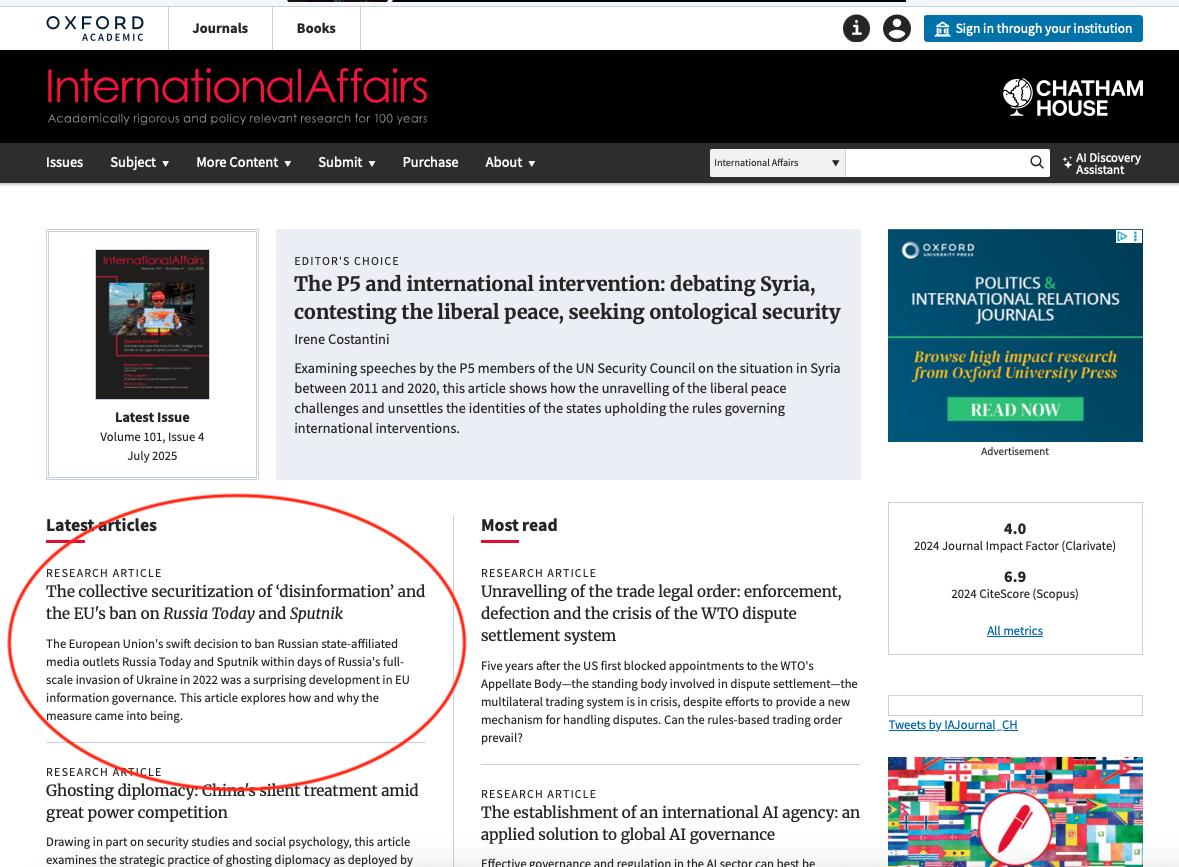
In my recent article, “The collective securitization of ‘disinformation’ and the EU’s ban on Russia Today and Sputnik” published in International Affairs (Oxford University Press), I analyse this pivotal moment. Using a theory called “collective securitisation”, I explored how and why the EU was able to pass a policy that seemed so inconsistent with its foundational norms. My analysis, which I hope is useful for policymakers, academics, and the public, suggests that this decision represents a new geopolitical turn in how information is governed and it could redefine the EU’s identity.

Hi! I’m Sophie
I am a social scientist and explorer. In my work, I analyse the intersection of politics, technology, and democracy. Nothing makes me happier than learning and discovering the wonders of the world. I consider myself an enthusiastic feminist and self-care advocate.
What is Collective Securitisation? (and why it explains the ban)
To put it simply, “securitisation” is the process of framing a political issue as a security issue. When an issue, for example migration or climate change, is framed as an existential threat, it becomes legitimate to adopt exceptional (and sometimes less democratic) policies that would normally be off-limits. This is done, intentionally or not, by state representatives and politicians when negotiating policy change.
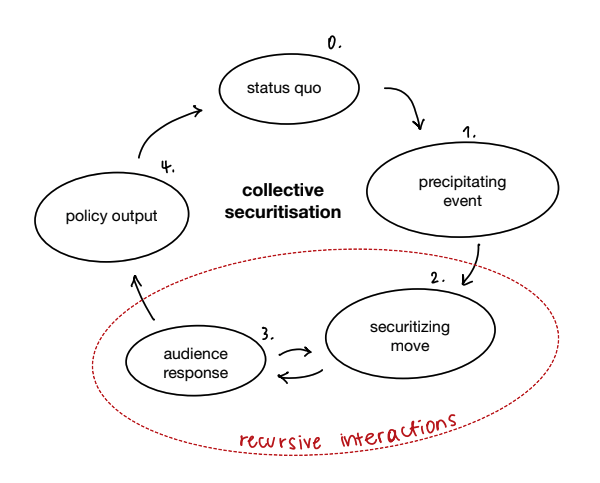
In the EU, this process may happen collectively. Institutions like the European Commission or the Council of the EU can act as a “securitising agent” for member states. The process follows a clear cycle, illustrated in Figure 1. In the case of EU disinformation policies, I observed:
The Status Quo: The original policy approach to disinformation in the EU was centred around voluntary codes of conduct and fact-checking.
A Precipitating Event: Russia’s full-scale invasion of Ukraine, which heightened attention towards misleading and false reports from Russia.
The Securitising Move: The Council of the EU declared that the propaganda from RT and Sputnik posed a “significant and direct threat to the Union’s public order and security”.
Recursive Interactions: EU institutions and member states (briefly) discussed and negotiated the issue, leading to a consensus.
The Policy Output: The adoption of Regulation (EU) 2022/350, which officially restricted the broadcasting of RT and Sputnik in the EU.
Figure 1: A model of collective securitisation
Source: Author’s elaboration, based on Sperling and Webber.
My research, based on interviews with officials and an in-depth review of 400+ policy documents, uncovered some fascinating details about how this process unfolded. The decision-making wasn’t a formal, public process. Instead, it happened informally in small, secretive meetings referred to as “confessionals”. In these meetings, high-level representatives from the Commission and the European External Action Service met with groups of ambassadors from EU member states. The ban was quickly put together, building on earlier proposals from the Baltic states. France, which held the Council’s rotating presidency, played a key role in getting the proposal adopted. While some countries like the Netherlands, Sweden, and Denmark were initially sceptical about the legal basis of the ban, the legal provisions were approved in “record time” under the pressure of the emergency. This process is illustrated in Figure 2.
Figure 2: The five-step process of the collective securitization of disinformation in the EU
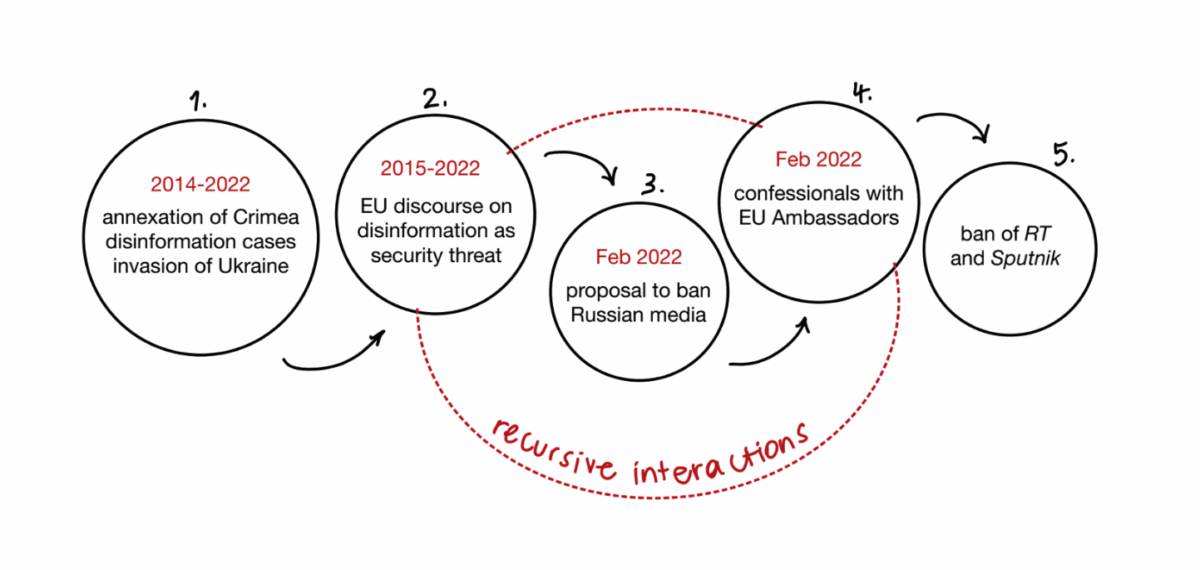
Source: Author’s elaboration, based on interviews 1–20.
What This Means for the Public
This story gives a glimpse into the functioning of EU institutions. It reveals how confidential meetings about sensitive issues such as foreign and security policy work in practice. It shows the very nature of our institutions and how our governments respond to crisis. The way this ban was implemented—through non-transparent meetings and fast-tracked procedures—raises serious questions about accountability and legitimacy. When a crisis allows for exceptional measures that bypass normal democratic checks and balances, it sets a dangerous precedent that may serve as an example for ill-intentioned actors.
It also highlights a critical debate: is a ban the right way to fight disinformation in the EU? As many have pointed out, including the UN Special Rapporteur, banning media outlets is a “very severe step” that might not be necessary or effective. Even the Norwegian government found that the best way to counter RT and Sputnik‘s false narratives is through “rebuttal and discussion in the public sphere,” not censorship.
My research shows that the ban was neither entirely effective, as the content from RT and Sputnik remained accessible through other platforms. It also gave the Russian government a perfect opportunity to frame the EU’s actions as censorship, feeding their own narrative. This raises the question: are we sacrificing core values like free speech for a policy that doesn’t even work?
Subscribe
for a monthly round-up of the latest advances in technology and global affairs, tips to thrive in academia, resources to support your personal growth, and more!
Key Takeaways for Scholars and Practitioners
For those in academia and policy-making, my research offers several key insights:
-
Understanding EU Decision-Making: My study reveals the new interconnectedness between security and media policies, as well as the growing importance of informal processes like the “confessionals” and emergency mechanisms such as sanctions in EU governance. This demonstrates how a crisis can empower certain actors to expand the EU’s competencies into new areas, such as media regulation. This is an essential lesson for anyone trying to understand the inner workings of power in Brussels.
-
Refining Securitisation Theory: My work refines the theory of collective securitisation by showing how “recursive interactions” between EU institutions and member states are crucial for legitimising security policies. I argue that this process is not just a top-down, elite-driven one, but a complex interaction where a persuasive “securitising move” gains traction through the acceptance of member states and the public through the media.
-
Normative and Practical Conclusions: The study raises a powerful challenge to the EU’s counter-disinformation efforts. It suggests that for a securitisation to be truly successful, it needs public legitimacy. The ban on RT and Sputnik, by touching on the EU’s foundational value of free speech without a democratic foundation, undermines this legitimacy. I argue that the EU’s focus on hybrid threats, including disinformation, can sometimes be a form of “ontological security management,” where the broadness of the concept is used for political gain, potentially at the expense of the EU’s own liberal-democratic identity.
The case of the RT and Sputnik ban is a powerful example of the EU’s ongoing struggle to balance security and strategy with its core values. It forces us to ask tough questions about how we govern information in the digital age, and what we are willing to give up in the name of security. I hope my research contributes to this vital conversation.
Read the full article
This piece was published as an advance article in International Affairs (OUP) for its September 2025 issue. It was anonymously reviewed by experts in the field and is available in open access, which means it’s free for anyone to download and read.